CVE-2026-90817: REDCap Survey Link to Server Takeover — Unauthenticated RCE on CISA KEV, Fixed in 16.0.49 / 17.3.10 / 17.4.4
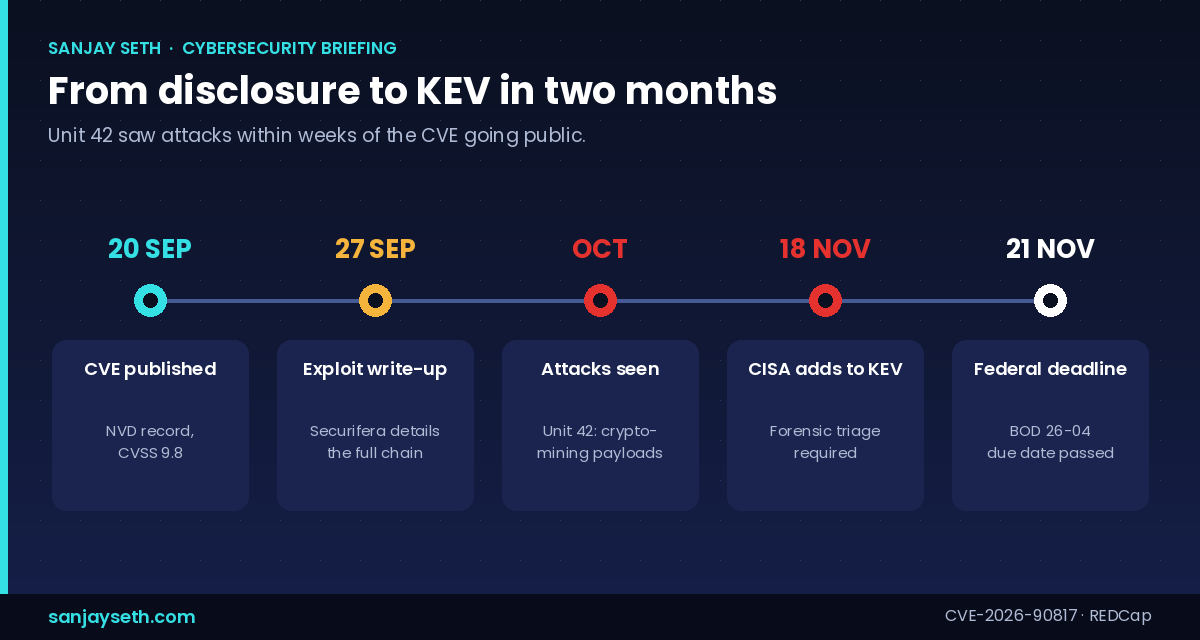
Every REDCap survey link you send out is a key to the front door. With CVE-2026-90817, that key is enough to run code on the server. An attacker who knows one valid public survey hash, the token in an ordinary survey URL, can reach REDCap’s administrative Data Import tool with no login, overwrite a compiled template and get remote code execution. Unit 42 has already seen it used to plant cryptominers, and CISA added it to the Known Exploited Vulnerabilities catalog on 18 November 2026. The federal deadline of 21 November has now passed.
REDCap is the research data platform from Vanderbilt University. The project’s own site counts more than 8,500 partner institutions in 167 countries. It’s often run by a research group rather than central IT. Someone stands it up on a VM for a study, and it quietly collects clinical and survey data for years. That’s exactly the profile attackers like.
Key takeaways
- Affected: REDCap 13.3.0 and higher, per the NVD record.
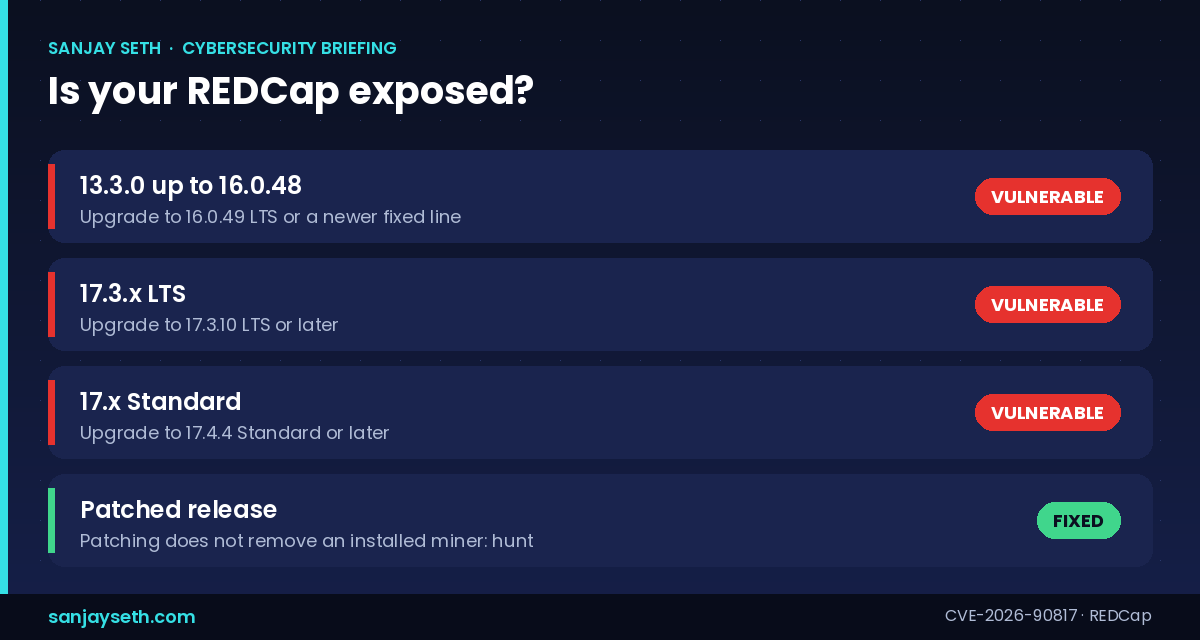
- Fixed in: 16.0.49 LTS, 17.3.10 LTS and 17.4.4 Standard. Upgrade to one of these or later.
- Pre-condition: a valid public survey hash, which is in every survey link you have ever sent.
- In the wild: Unit 42 observed attackers abusing public survey endpoints to deploy evasive cryptomining payloads.
- Patching isn’t cleanup: an upgrade closes the door but won’t remove a miner or persistence that’s already there.
01What happened
The flaw was published on 20 September 2026 (NVD), reported by the research firm Securifera. On 27 September, Securifera’s researcher published a full write-up of the exploit chain. One detail worth noting: he found the bug by pointing an AI coding agent at a leaked copy of the REDCap source. That’s the world we’re in now. Bugs in “obscure” software get found faster than they used to.
Palo Alto’s Unit 42 then reported in-the-wild exploitation, with attackers abusing public survey endpoints to bypass admin access controls and deploy cryptomining payloads. On 18 November, CISA added the flaw to the KEV catalog in the same batch as the Apache Axis bug behind the Confluence attacks I covered earlier. The entry carries a forensic triage requirement, so federal agencies have to check for compromise as well as patch.
02How the exploit chain works
This isn’t one bug. Securifera describes five ordinary-looking weaknesses that only become dangerous together:
- A double decode opens the route. The public survey handler has a “passthrough” feature that may load the root dispatcher only for the PDF route. The allowlist check URL-decodes
__passthrutwice, while the route restriction compares the once-decoded value. Send%2569ndex.phpand one check seesindex.phpwhile the other doesn’t, so the attacker picks any controller, such asDataImportController:index. - Rights are calculated too early. REDCap builds the user-rights object before the survey identity exists, and treats an undefined super-user flag as “super user”. The anonymous survey visitor inherits the Data Import privilege, and CSRF checks are skipped.
- A filename becomes a PHP stream. Data Import trusts the posted
fnamevalue as a local path, so it acceptsphp://filterURIs. - A BOM clean-up becomes a write. The CSV routine strips a byte-order mark and writes the result back to the same resource. A crafted filter chain turns that into an exact overwrite.
- A template cache becomes code execution. The overwrite targets a predictable, writable compiled Blade template, which the application later includes as PHP.
| Attribute | Detail |
|---|---|
| CVE | CVE-2026-90817 |
| Score | CVSS 3.1 9.8 · AV:N/AC:L/PR:N/UI:N/S:U/C:H/I:H/A:H |
| Weakness | CWE-94 code injection, CWE-73 external control of file name or path |
| Component | Survey passthrough routing and Data Import processing |
| Affected | REDCap 13.3.0 and higher |
| Fixed in | 16.0.49 LTS · 17.3.10 LTS · 17.4.4 Standard |
| Pre-condition | Knowledge of a valid public survey hash |
| CISA KEV | Added 18 Nov 2026 · due 21 Nov 2026 · forensic triage required |
03Am I affected?
If you run REDCap 13.3.0 or later and haven’t upgraded to a fixed release, assume yes. The “survey hash” requirement is not a real barrier. Surveys are meant to be public, and the hash is in every invitation email, SMS and QR code your study ever sent out.
04What attackers are doing
Unit 42 reported attackers using public survey endpoints to bypass admin controls and drop evasive cryptocurrency mining payloads. Public write-ups of that campaign describe a familiar pattern. A single request stages a short-lived web shell. An in-memory loader then fetches XMRig disguised as image files and renames the miner to look like syslog-ng. Persistence comes from cron and an added SSH key.
Cryptomining sounds like a nuisance. I’d treat it as a symptom. Whoever ran the miner had code execution on a server holding research participants’ data, and an SSH key that will outlive your patch. CISA lists ransomware use as “unknown”. Don’t plan around that word.
The University of Florida’s CTS-IT team has published a read-only scanner, redcap_cve_2026_90817_scan. It checks a host for the campaign’s artefacts, including the miner’s local API socket on 127.0.0.1:50001, the syslog-ng masquerade and cron persistence, without sending any exploit traffic.
05What you should do today
- Find every REDCap instance. Ask research departments, not just IT. Check DNS, certificates and your firewall NAT rules for anything answering on a survey URL. Departmental VMs and “pilot” servers are the usual blind spot.
- Upgrade to a fixed release. 16.0.49 LTS, 17.3.10 LTS or 17.4.4 Standard, or anything later on your track. Do it out of cycle. A KEV listing with exploitation is the change window.
- If you truly can’t upgrade today, contain. Securifera’s guidance is to restrict or disable public surveys and block survey-context access to the root dispatcher,
DataImportControllerandParcelController. A WAF rule for encoded__passthruvalues helps. Treat all of this as temporary. - Hunt, even after patching. Look in web logs for encoded
__passthruvalues and survey requests toDataImportController:indexorParcelController:show, forfnamevalues containingphp://or filter strings, unexpected changes under REDCap’stemp/cache folders, child processes of the web server account, unexplained CPU load, new cron entries and new keys inauthorized_keys. Run the CTS-IT scanner. - If anything turns up, treat it as a breach. Isolate the server, preserve evidence, rotate database and service credentials, and assess what participant data was reachable. My notes on the first 60 minutes of an incident apply here too.
- Put research platforms under IT governance. Same patch SLA, same monitoring, same asset register as everything else. I made the same argument about clinical devices in what DICOM and HL7 taught me about unpatchable devices.
06How PrahiX ORA could have saved you
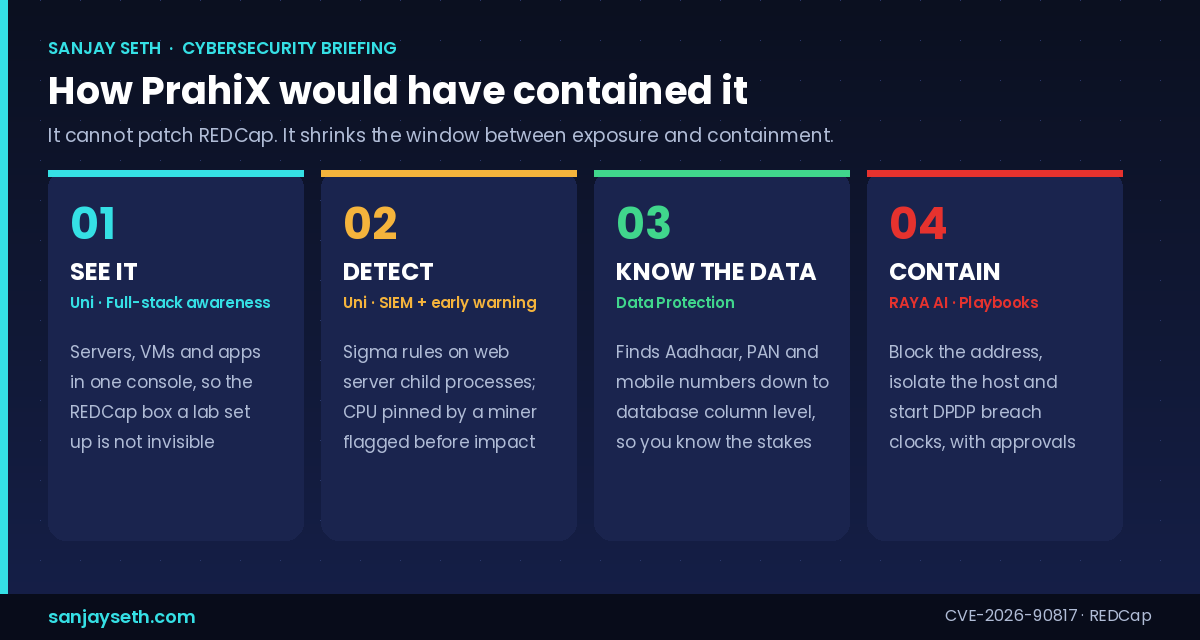
To be clear first: no platform rewrites REDCap’s code. Only the upgrade does that. But look at the timeline. Securifera’s write-up was public from 27 September, and the KEV listing only came on 18 November. In between, attackers were planting miners on exposed servers. Research platforms like this often sit outside central IT’s view, on a lab’s VM with nobody watching the logs. That blind spot is exactly what PrahiX ORA is built to close. Servers, applications, logs and the personal data behind them land in one place, and RAYA AI turns the fragments into one incident with its cause.
Stage by stage: what ORA would have done
| What the attacker did | What ORA and RAYA do |
|---|---|
| Weeks before: an unpatched REDCap on a departmental VM, survey links public | Ingest + awareness. PrahiX Uni puts servers, VMs, databases and applications on the Central Console, with topology discovered automatically, so the lab’s REDCap box is in the inventory. GRC auto-ingests CERT-In advisories, so “which of our servers runs this?” has an answer early. |
Initial access: encoded __passthru survey request reaches Data Import | Correlate. Web and application logs arrive within 10 seconds. A Sigma detection mapped to MITRE ATT&CK can flag encoded __passthru values or php:// in fname, and IOC matching from 10+ threat-intel feeds covers known attacker infrastructure. |
| Code execution: Blade template overwritten, the web worker spawns a shell | Attack storylines build a graph of processes, hosts, files and connections that rebuilds the kill chain from the first request. UEBA scores the web server’s new behaviour as high risk. |
| Miner running as fake syslog-ng, with cron and SSH key persistence | RAYA AI early warning flags trouble 15–45 minutes before users feel it, so a CPU pinned at 3 a.m. becomes part of the same incident instead of a separate P4 ticket. Honeypots and canary files fire a playbook if the intruder goes exploring. |
| What data was in reach? | PrahiX Data Protection scans databases down to column level for 14 Indian identifiers, including Aadhaar, PAN and mobile numbers, with a 0–100 risk score. You know what participant data sat behind the server before a regulator asks. |
| Respond | RAYA runs the containment you allowed: isolate the host, block the address. An approval gate sits on anything disruptive, and every step lands in one immutable audit trail, which is the evidence a forensic-triage requirement asks for. |
| After: regulator and ethics committee questions | GRC starts the breach clocks when the incident is logged (CERT-In 6 hours, DP Board 72 hours) and drafts reports mapped to CERT-In and the DPDP Act. Evolve: each outcome makes the next response faster. |
What’s inside PrahiX ORA
Collects every signal from any vendor or format, ties it to an asset, site and user, and runs four automatic steps: Ingest → Correlate → Respond → Evolve.
The agent inside ORA. It joins related alerts into one incident with a root cause, self-heals within your limits and rolls back a failed fix. It also warns 15–45 minutes before users feel a problem and writes a plain-language morning summary.
Every site, device and service live on one screen. Role-based views and a library of ready-made dashboards let you go from a chart to an incident, device or log line in one click.
Tracks CERT-In, DPDP Act, RBI, SEBI CSCRF, IRDAI, ISO 27001 and more. It shows what’s due and what’s missing, and produces sealed evidence and ready-to-submit reports.
Monitoring, AIOps, SIEM, SOAR and self-healing in one product: Sigma detections mapped to MITRE ATT&CK, UEBA, attack storylines, deception, playbooks with approval gates and 180 days of searchable logs.
Finds personal data (14 Indian identifiers) and stops leakage across 12 channels. It also tracks every DPDP Act clock, with 62 controls on one scorecard.
REST APIs and webhooks to the tools you already run. Parser Lab adds any source in any format, and detections and playbooks are kept as version-controlled code.
Multi-tenant from one site to 100+ client tenants, with India compliance built in plus CIS v8, NIST CSF, PCI-DSS, HIPAA, ISO 27001 and SOC 2 mappings. Made in India.
The honest bottom line
ORA would not have patched REDCap. It would have put the forgotten research server in the inventory, turned the first odd survey request into a P1 incident with its cause already written, and tied the miner’s CPU spike to that incident instead of a separate ticket. It would also have told you which participant data was in reach. The upgrade and the clean-up still belong to your team. ORA makes sure you are never the last to know. P J Networks is an implementation partner for PrahiX, and we run ORA deployments end to end. Book an ORA demo with us.
07The India angle
Wherever REDCap runs, in India as anywhere else, it tends to live under a study’s grant rather than a central IT budget. That’s the worst combination for a bug like this: internet-facing by design, holding personal data, and maintained when someone remembers to.
The legal stakes are rising too. Under the Digital Personal Data Protection Act 2023 and the DPDP Rules 2025, research institutions acting as Data Fiduciaries carry a duty of reasonable security safeguards. Most obligations apply from May 2027. CERT-In’s six-hour incident reporting rule already applies today. If a REDCap server holding participant data was compromised, you need to be able to show when you found out and what you did. Logs and an asset register are what make that possible.
08Frequently asked questions
Which REDCap versions fix CVE-2026-90817?
16.0.49 LTS, 17.3.10 LTS and 17.4.4 Standard. Every release from 13.3.0 onward is affected until upgraded to a fixed release on its track.
Does an attacker need a REDCap login?
No. They need a valid public survey hash, which is part of every public survey link. That’s why this is effectively an unauthenticated remote code execution bug.
We patched. Are we safe?
Patching closes the entry point but doesn’t remove anything an attacker already installed. Hunt for web shells, XMRig processes posing as syslog-ng, new cron jobs and unknown SSH keys, and review web logs for encoded __passthru requests.
What can we do if we cannot upgrade immediately?
Restrict or disable public surveys and block survey-context access to the root dispatcher, the Data Import controller and the Parcel controller. Treat that as temporary containment and upgrade as soon as possible.
Not sure whether your research servers are clean?
My team at P J Networks can find every REDCap and research-facing server you run, check versions, run the compromise hunt and set up monitoring with PrahiX, so the next research-platform CVE reaches you as an alert rather than a breach notice.
Request a security assessment →