CVE-2026-76460 (CVSS 10): Exploited Cisco ISE Auth Bypass — Patch Matrix, IOCs and the CVE-2026-76423 Fix
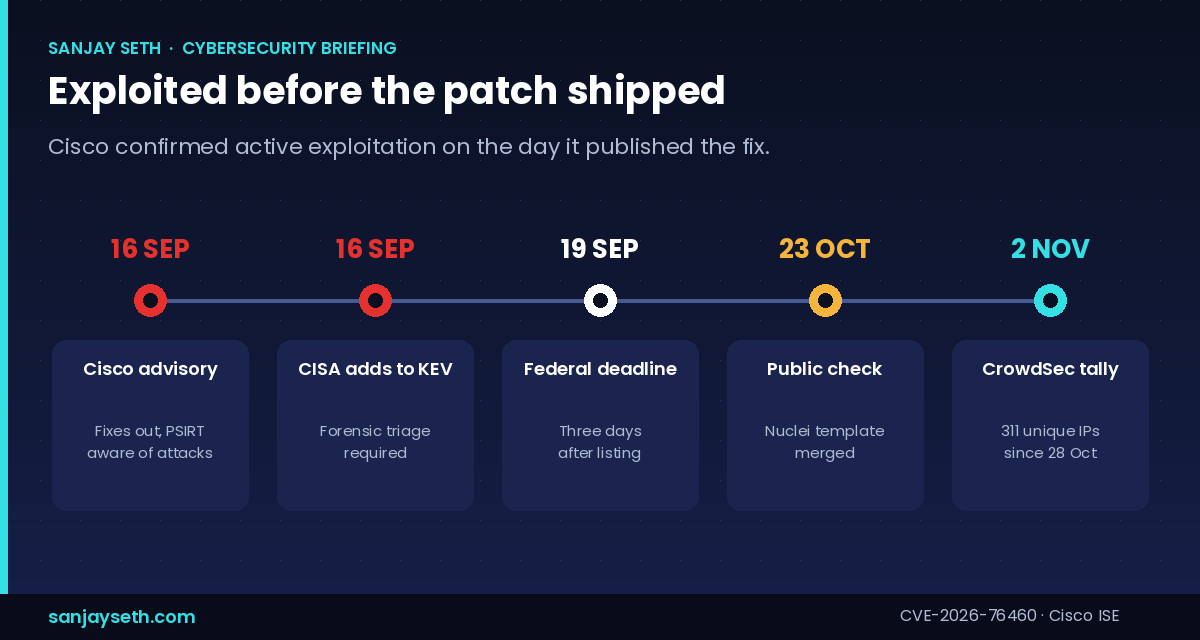
Cisco ISE CVE-2026-76460 is the kind of bug I hate most: a CVSS 10.0 authentication bypass in the box that decides who gets on your network. Cisco disclosed it on 16 September 2026 and said in the same breath that it was already being exploited. CISA listed it the same day. Two months on, CrowdSec’s sensors are still counting fresh attackers, and I still meet ISE nodes that haven’t been patched.
Cisco also fixed a second CVSS 10.0 flaw, CVE-2026-76423, in the same release cycle. I’ll be precise about it, because a lot of coverage blurred the two: Cisco says it has not seen CVE-2026-76423 exploited. Patch it anyway. The same fixed releases close both.
Key takeaways
- CVE-2026-76460 (CWE-648) lets an unauthenticated attacker reach an ISE API endpoint and bypass the web management interface. Cisco warns attackers may get root command execution.
- It affects Cisco ISE and ISE-PIC regardless of configuration, and it is in CISA’s KEV catalog with forensic triage required.
- CVE-2026-76423 is a separate REST API bypass giving admin access to configuration and identity data. Cisco reports no known exploitation.
- Fixed in: 3.1 Patch 12, 3.2 Patch 11, 3.3 Patch 12, 3.4 Patch 7, 3.5 Patch 4. ISE 3.0 gets no fix, so migrate.
- Patching isn’t enough. Check every node’s
access.logfor unexpected usernames and re-image anything suspicious.
01Why an ISE bypass is worse than most
ISE is where your zero-trust policy actually lives. It answers every 802.1X and MAB request, holds the RADIUS and TACACS+ policy for your switches and firewalls, runs posture checks, and stores the admin accounts and certificates that tie it all together. When I design a zero-trust campus, the NAC is the trust broker. Compromise it, and the attacker doesn’t just own one server. They decide who else gets in.
That’s why CISA flagged this one for forensic triage, not just patching. It’s also the third Cisco ISE entry in the KEV catalog, after two critical 2025 flaws (CVE-2025-20281 and CVE-2025-20337). If ISE is in your estate, assume it is on attackers’ target lists.
02The two flaws, side by side
| CVE-2026-76460 | CVE-2026-76423 | |
|---|---|---|
| Advisory | cisco-sa-ISE-ABP-VNSW7Tn5 | cisco-sa-ise-multi-hrP9jQSQ |
| CVSS 3.1 | 10.0 Critical | 10.0 Critical |
| Weakness | CWE-648, incorrect use of privileged APIs | CWE-290, authentication bypass |
| Impact | Unauthorised access bypassing the web management UI; Cisco notes possible root command execution | Admin access to read and modify ISE configuration and identity data |
| Affects | ISE and ISE-PIC, any configuration | ISE and ISE-PIC, any configuration |
| Exploited? | Yes: Cisco PSIRT aware; in CISA KEV | Cisco not aware of malicious use |
| Found by | Cisco, during a TAC support case | STAR Labs SG |
| Bug ID | CSCww39530 | CSCwu39998 |
CVE-2026-76423 shipped in a bundle of six. The other five, CVE-2026-76424 through CVE-2026-76428, cover authenticated file upload leading to root, SQL injection and XXE. They need credentials, but chained behind an auth bypass, that’s cold comfort.
03How the attack works
Cisco keeps the details thin, but its CVE description is clear about the shape: insufficient authentication control on an API endpoint means a crafted request bypasses the web-based management interface. Cisco’s own indicator is a fake username such as dummyuser turning up in the API gateway’s access log. That tells you attackers are talking to the API as an identity that was never created.
On 23 October a public Nuclei detection template appeared that reads the active-session list using a made-up cookie. CrowdSec began tagging attempts on 28 October and counted 311 unique IPs by 2 November. As of that report there was no public code reaching root. Cisco, though, says real attackers may already have it, and warns they can hide their tracks once they do.
04Patch matrix and the 3.1/3.2 problem
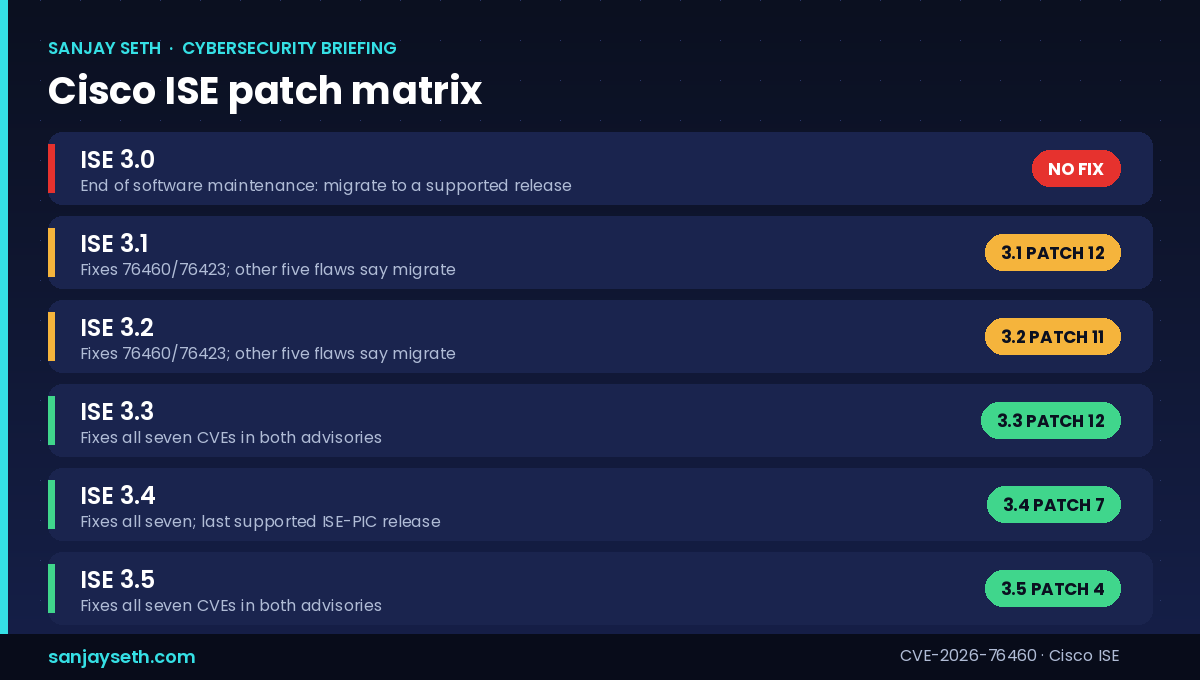
Read Cisco’s second advisory closely. On 3.1 and 3.2, the patches close CVE-2026-76460 and CVE-2026-76423, but for the other five flaws in that bundle Cisco’s answer is “migrate to a fixed release“. Both trains are also on Cisco’s end-of-life path. My advice: patch tonight to stop the exploited bug, then book the move to 3.3, 3.4 or 3.5 as a project with a date on it. ISE-PIC customers should note that 3.4 is the last supported PIC release.
05What you should do today
If you’ve already patched, good. Most of this list still applies, because the flaw was exploited before anyone could patch.
- List every ISE and ISE-PIC node with its version and patch level. Include every persona in a distributed deployment, plus lab and DR nodes.
- Patch to the fixed release for your train (see the matrix). If you’re on 3.0, start the migration now. There’s nothing to patch.
- Lock down management access. Cisco’s own mitigation is infrastructure ACLs that allow only required management and control-plane traffic to ISE. On a FortiGate, that’s an address group for your admin jump hosts and an explicit deny for everything else hitting the ISE admin and API interfaces. It’s also one of the misconfigurations I find on almost every firewall.
- Hunt for the indicator on every node. Run
show logging application ise-kong/access.log | include dummyuser, then pull a support bundle with debug logs and search./ise/logs/apigateway/access.log.*.gzfor usernames you didn’t create. - Look outside the box. Cisco warns that attackers with root can wipe evidence. Review firewall and flow logs for uploads from ISE to external IPs, or downloads from unknown ones.
- If anything looks wrong, re-image. Cisco recommends re-imaging affected nodes and restoring from a known-good configuration backup. Then rotate the admin, RADIUS and TACACS+ shared secrets and AD bind accounts ISE uses. My notes on the first 60 minutes of an incident cover the order of operations.
This isn’t the only Cisco management-plane problem this month. Later the same day I covered CVE-2026-76466, the hard-coded credential that lets attackers root Cisco Expressway clusters. Same lesson: keep management interfaces off reachable networks.
06How PrahiX ORA could have saved you
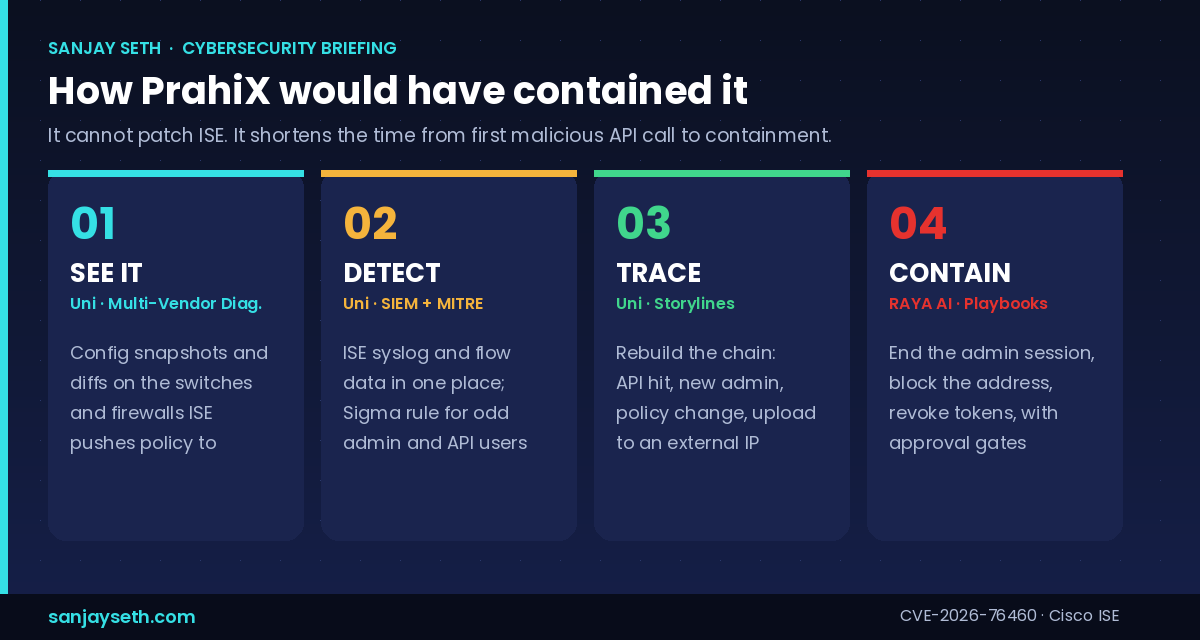
To be clear first: no platform patches ISE for you. Only Cisco’s fixed release does that. But this bug was exploited before a patch existed, and Cisco warns that attackers with root can wipe the evidence on the box. So the real question was never “how fast did you patch”. It was how fast did anyone notice a fake API user, a new admin or an odd upload from the NAC. That is the gap PrahiX ORA is built to close. ISE syslog, switch and firewall configuration, flow records and identity signals all land in one place, and RAYA AI turns them into one incident with its cause.
Stage by stage: what ORA would have done
| What the attacker did | What ORA and RAYA do |
|---|---|
| Before: unpatched ISE and ISE-PIC nodes, management and API reachable from too many networks | Ingest + awareness. Agentless discovery (SNMP, SSH, REST APIs) puts every node and its version on the Central Console. GRC tracks advisories, and CERT-In advisories are auto-ingested into threat intelligence, so “which ISE nodes are still unpatched?” has an answer the day Cisco publishes. |
| Initial access: crafted API request as a user that was never created | Correlate. ISE syslog arrives within 10 seconds, alongside everything else. A Sigma detection mapped to MITRE ATT&CK flags API sessions from users that don’t exist (Cisco’s own dummyuser indicator), and IOC matching from 10+ threat-intel feeds recognises known scanning sources. |
| Takeover: rogue admins, policy changes | Configuration snapshots and diffs on the switches and firewalls ISE controls show what changed, where and when, even if the logs on ISE itself have been wiped. UEBA scores the new admin behaviour as high risk. |
| Data out: uploads from ISE to external IPs | Flow records from your firewalls are independent evidence that the attacker can’t erase from ISE. Attack storylines join the API anomaly, the admin change and the outbound flow into one kill chain. |
| Containment | Respond. RAYA runs the containment you allowed: end the unusual admin session, block the source address, revoke tokens. An approval gate sits on anything disruptive, and every step lands in one immutable audit trail, which is the evidence a forensic-triage requirement asks for. |
| After: regulator and Board questions | GRC starts the breach clocks when the incident is logged (CERT-In 6 hours, DP Board 72 hours) and drafts reports mapped to CERT-In, DPDP, RBI, SEBI CSCRF and IRDAI. Evolve: each outcome makes the next response faster. |
What’s inside PrahiX ORA
Collects every signal from any vendor or format, ties it to an asset, site and user, and runs four automatic steps: Ingest → Correlate → Respond → Evolve.
The agent inside ORA. It joins related alerts into one incident with a root cause, self-heals within your limits and rolls back a failed fix. It also warns 15–45 minutes before users feel a problem and writes a plain-language morning summary.
Every site, device and service live on one screen. Role-based views and a library of ready-made dashboards let you go from a chart to an incident, device or log line in one click.
Tracks CERT-In, DPDP Act, RBI, SEBI CSCRF, IRDAI, ISO 27001 and more. It shows what’s due and what’s missing, and produces sealed evidence and ready-to-submit reports.
Monitoring, AIOps, SIEM, SOAR and self-healing in one product: Sigma detections mapped to MITRE ATT&CK, UEBA, attack storylines, deception, playbooks with approval gates and 180 days of searchable logs.
Finds personal data (14 Indian identifiers) and stops leakage across 12 channels. It also tracks every DPDP Act clock, with 62 controls on one scorecard.
REST APIs and webhooks to the tools you already run. Parser Lab adds any source in any format, and detections and playbooks are kept as version-controlled code.
Multi-tenant from one site to 100+ client tenants, with India compliance built in plus CIS v8, NIST CSF, PCI-DSS, HIPAA, ISO 27001 and SOC 2 mappings. Made in India.
The honest bottom line
ORA would not have patched ISE, and it couldn’t have stopped an exploit that existed before the fix. What it would have done is turn the first fake API user into a P1 incident with its cause already written. It would also have kept independent evidence, in flow records and config diffs, that an attacker with root on ISE can’t wipe, and contained the session before policy and admin accounts were rewritten. The iACLs and the patch still belong to your team. ORA makes sure you are never the last to know. P J Networks is an implementation partner for PrahiX, and we run ORA deployments end to end. Book an ORA demo with us.
07The India angle
ISE is common in Indian banks, insurers, large IT parks and PSUs, often because a regulator asked for proper NAC and ISE was the default choice. Those same entities live under RBI’s cyber framework, SEBI’s CSCRF or IRDAI’s guidelines, and all of them must report incidents to CERT-In within six hours. A compromised NAC is exactly the incident you want to discover yourself, with your own logs, rather than from a third party. Singapore’s CSA issued its own alert (AL-2026-126). Regional regulators are watching this one.
08Frequently asked questions
Is Cisco ISE CVE-2026-76460 being actively exploited?
Yes. Cisco’s PSIRT said it was aware of active exploitation when it published the advisory on 16 September 2026, and CISA added it to the Known Exploited Vulnerabilities catalog the same day. CrowdSec logged 311 unique attacking IPs between 28 October and 2 November.
Is CVE-2026-76423 exploited too?
Not as far as Cisco knows. Its advisory says the PSIRT is not aware of malicious use. It’s still a CVSS 10.0 admin-access bypass, and the same fixed releases close it, so patch both together.
Which Cisco ISE versions fix CVE-2026-76460?
3.1 Patch 12, 3.2 Patch 11, 3.3 Patch 12, 3.4 Patch 7 and 3.5 Patch 4. ISE 3.0 is past end of software maintenance and gets no fix. Migrate to a supported release.
How do I check whether my ISE was compromised?
On every node, run “show logging application ise-kong/access.log | include dummyuser” and search the API gateway access logs in a debug support bundle for unexpected usernames. Then check firewall and flow logs for uploads from ISE to external IPs. If anything looks suspicious, Cisco recommends re-imaging and restoring from configuration backup.
Want a second pair of eyes on your ISE deployment?
My team at P J Networks can verify patch levels across every node, run the access-log and flow-log hunt, tighten management-plane ACLs on your firewalls, and plan the move off 3.1/3.2, so your NAC stays the gatekeeper and not the way in.
Request a security assessment →Sources
- Cisco Security Advisory: cisco-sa-ISE-ABP-VNSW7Tn5 (CVE-2026-76460)
- Cisco Security Advisory: cisco-sa-ise-multi-hrP9jQSQ (CVE-2026-76423 to 76428)
- CISA Known Exploited Vulnerabilities Catalog (added 16 Sep 2026, due 19 Sep 2026)
- NVD: CVE-2026-76460
- CrowdSec VulnTracking report on CVE-2026-76460 (2 Nov 2026)
- Help Net Security: Unauthenticated attackers are bypassing Cisco ISE’s management interface
- Cyber Security Agency of Singapore: Alert AL-2026-126