CVE-2026-76466: Cisco Expressway Clusters Rooted via Hard-Coded Credential — Patch to X15.5.20 Before 23 Nov
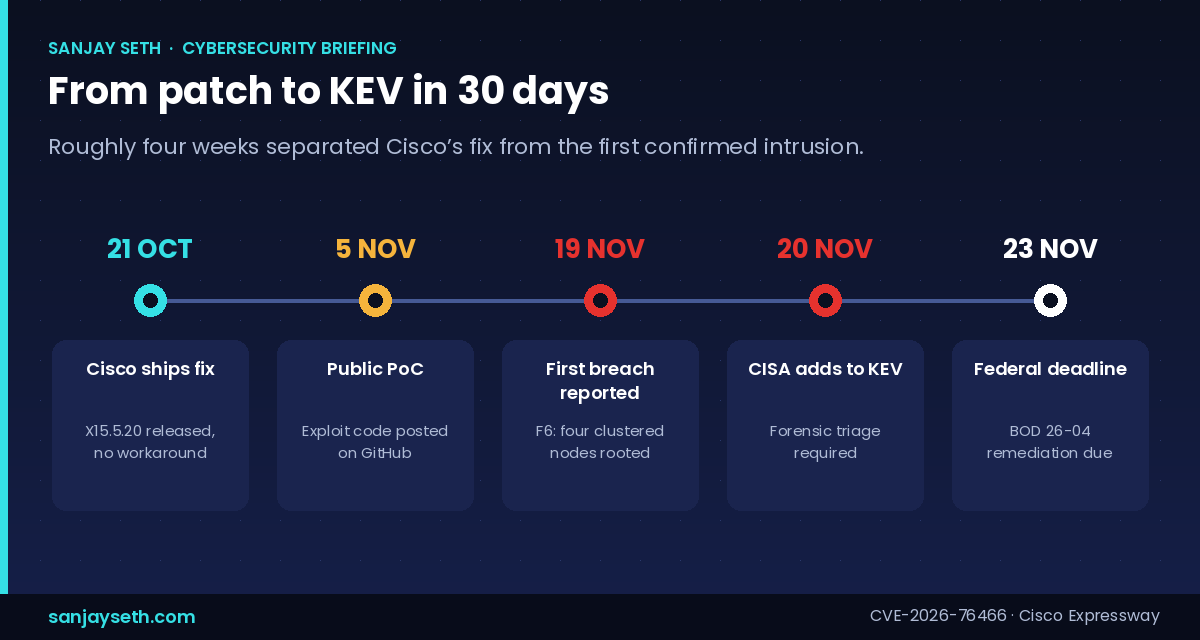
If you run a clustered Cisco Expressway, stop and check your version before you finish this coffee. CVE-2026-76466 lets anyone who can reach the cluster database port run commands as root, with no username, no password and no user interaction. Cisco fixed it a month ago. Public exploit code followed on 5 November, the first confirmed intrusion was reported on 19 November, and on 20 November CISA put it on the Known Exploited Vulnerabilities list with a federal deadline of 23 November 2026.
I’ve spent a good part of thirty years looking after perimeter boxes, and video and voice gateways are the ones that get forgotten. They’re “the UC team’s thing”. They sit in the DMZ, they rarely get rebooted, and nobody wants to touch them before the CEO’s town hall. This bug punishes exactly that habit.
Key takeaways
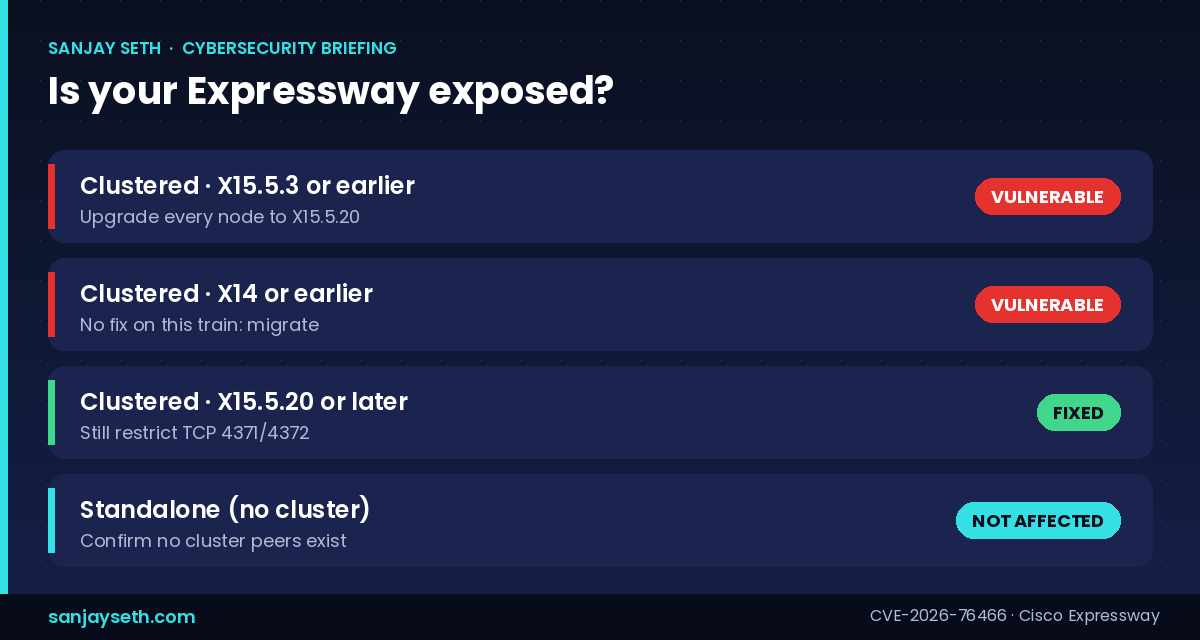
- Only clustered Expressway-C and Expressway-E nodes (virtual and appliance) are affected. Standalone nodes are not.
- The cause is a hard-coded maintenance identity and cookie in the Erlang-based cluster database service, identical on every install (CWE-798).
- Fix: X15.5.3 and earlier → upgrade to X15.5.20. X14 and earlier have no fix on that train, so you have to migrate.
- Attackers used the public PoC to root four clustered nodes at one organisation, two of which were never exposed to the internet.
- Until you’ve patched, allow TCP 4371 and 4372 only between known cluster peers, then look for signs of compromise.
01What happened
On 21 October 2026, Cisco published advisory cisco-sa-vcs-static-cred-hr7EWZ8t (bug ID CSCww27732) as part of its October Expressway hardening release. In its own words, the database service “could allow an unauthenticated, remote attacker with network access to a Cisco Expressway device to execute arbitrary operating system commands as root.” Cisco says it is caused by “the use of persistent cookies” plus missing validation of client certificates, even when TLS Verify Mode is enabled for clustering.
When the advisory went out, Cisco’s PSIRT knew of no malicious use. That changed quickly. A working exploit appeared on GitHub on 5 November. On 19 November, the Russian security firm F6 reported the first known intrusion, and the next day CISA added the CVE to the KEV catalog with a 23 November due date. The KEV entry also says forensic triage is required, so patching alone doesn’t clear it. Agencies are expected to check whether they were already breached.
02How the attack works
Expressway nodes in a cluster keep their configuration in sync through a database service built on Erlang/OTP, which listens on TCP 4372. Erlang nodes trust each other through a shared “cookie”. Analyses of the patch by ThreatFrontier and others show the cluster manager module adds a hard-coded maintenance node identity to its list of allowed peers, with a cookie that is the same on every Expressway in the world.
Once you know the identity and the cookie, the rest is standard Erlang. Connect over TLS, complete the distribution handshake, then use rpc:call to invoke os:cmd on the target. The public PoC runs id -u and gets back 0, which means root. Because client certificates aren’t validated, enabling TLS verification for clustering doesn’t help.
| Attribute | Detail |
|---|---|
| CVE | CVE-2026-76466 (Cisco bug CSCww27732) |
| Score | CVSS 3.1 9.8 · AV:N/AC:L/PR:N/UI:N/S:U/C:H/I:H/A:H |
| Weakness | CWE-798, use of hard-coded credentials |
| Component | Expressway database service (Erlang distribution, TCP 4372) |
| Affected | Clustered Expressway-C and Expressway-E, virtual and appliance, X15.5.3 and earlier, X14 and earlier |
| Fixed in | X15.5.20 (X14 and earlier: migrate) |
| Workaround | None from Cisco |
| CISA KEV | Added 20 Nov 2026 · due 23 Nov 2026 · forensic triage required |
03Am I affected?
Ask two questions: is it clustered, and which release is it running? Many deployments start as a single node and pick up a peer during a capacity or high-availability project, so check the clustering configuration in the web admin rather than relying on memory or an old design document.
04What attackers did after getting in
The F6 case, summarised by Secure.com, shows why “it’s just the video gateway” is the wrong way to think about this. The intruders compromised two internet-facing Expressway nodes running X15.5.3. Cluster trust then took them to two internal nodes that had never been exposed to the internet. From there they ran custom Python scripts to scan SMB shares, probe SQL Server and WinRM, and pull credentials out of internal GitLab repositories. F6 also says the attackers edited their scripts during the intrusion, and that code comments suggest an AI assistant helped write them.
No group has been named. CISA lists ransomware use as “unknown”. I’d still plan as if the next actor to use this PoC will be after more than credentials. Initial access to a rooted gateway with a trusted path inside is worth a lot on the access-broker market.
F6’s published indicators (defanged; a hit is a lead, not proof):
05What you should do today
This is what I’m asking clients to do, in this order. Don’t wait for the next change window. A KEV listing with a public PoC is the change window.
- Inventory every Expressway node and its peers. Include lab, DR and “temporary” clusters. Record release, cluster membership and which nodes face the internet.
- Restrict TCP 4371 and 4372 now. On your perimeter and internal firewalls, allow these ports only between known cluster peer IPs and deny everything else, including from the internet and from user VLANs. On a FortiGate that means a tight address group plus an explicit deny policy above any broad DMZ rules. This buys you time. It isn’t a fix.
- Upgrade every clustered node to X15.5.20. Follow Cisco’s cluster upgrade order. If you’re on X14 or earlier, open a P1 with your Cisco partner for migration, because no X14 patch is coming.
- Hunt before and after you patch. Check
erlang.logfor unknown node names, look for Python files under/mnt/harddisk/, review cluster peer lists for anything you don’t recognise, and search firewall logs for the F6 IPs and for non-peer traffic to 4371/4372. - If you find anything, treat it as a breach. Isolate the node, preserve evidence, rotate every credential the cluster could see (CUCM application users, LDAP binds, certificates), and hunt for lateral movement to SMB, SQL, WinRM and Git servers.
- Fix the process. Put UC gateways on the same patch SLA as firewalls and VPNs. If you need a template, my notes on the first 60 minutes of a ransomware incident apply almost word for word.
This is the second critical Cisco flaw I’ve written about today. This morning it was the Cisco ISE zero-days (CVE-2026-76460 and CVE-2026-76423). The common thread is implicit trust between infrastructure components, which is the first thing a zero-trust segmentation design should remove.
06How PrahiX ORA could have saved you
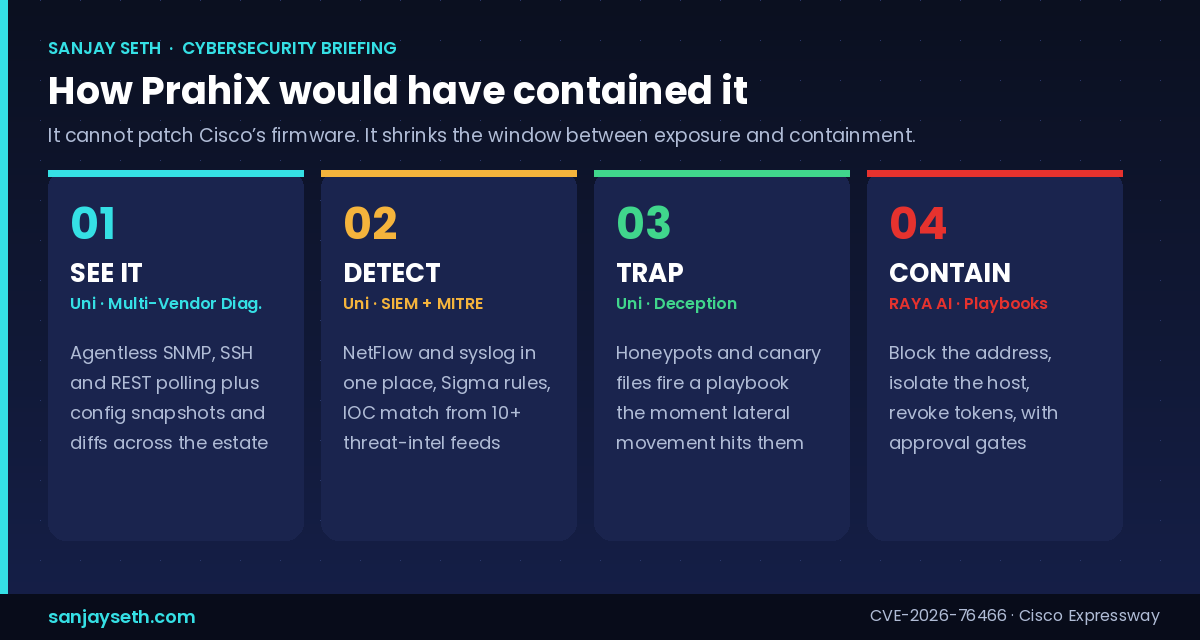
To be clear first: no platform can remove a credential Cisco compiled into its own firmware. Only X15.5.20 does that. But look at the F6 case again. The fix existed for four weeks, and the attackers moved from a DMZ gateway to internal nodes, then to SMB, SQL, WinRM and GitLab, without anyone joining the dots. That gap is exactly what PrahiX ORA is built to close. Network, security, cameras, cloud and identity signals all land in one place, and RAYA AI turns them into one incident with its cause.
Stage by stage: what ORA would have done
| What the attacker did | What ORA and RAYA do |
|---|---|
| Weeks before: unpatched clustered nodes, TCP 4372 reachable | Ingest + awareness. Agentless discovery (SNMP, SSH, REST APIs) puts every node, its release and its peers on the Central Console. GRC tracks advisories, and CERT-In advisories are auto-ingested into threat intelligence, so “who still runs X15.5.3?” has an answer the day the fix ships. |
| Initial access: non-peer joins the Erlang cluster | Correlate. Flow records (NetFlow/sFlow/IPFIX) and syslog are fresh within 10 seconds. A Sigma detection mapped to MITRE ATT&CK flags any non-peer on 4371/4372, and IOC matching from 10+ threat-intel feeds recognises F6’s attacker IPs. |
| Root on the gateway | Configuration snapshots and diffs show a cluster or config change that no change ticket explains. UEBA scores the gateway’s new behaviour as high risk. |
| Lateral movement: SMB, SQL, WinRM scans | Attack storylines rebuild the kill chain from initial access as it happens. Honeypots and canary files fire a playbook the moment the scripts touch them. |
| Credential theft from GitLab | Respond. RAYA runs the containment you allowed: block the address, isolate the host, revoke tokens. An approval gate sits on anything disruptive, and every step lands in one immutable audit trail, which is the evidence a forensic-triage requirement asks for. |
| After: regulator and Board questions | GRC starts the breach clocks when the incident is logged (CERT-In 6 hours, DP Board 72 hours) and drafts reports mapped to CERT-In, DPDP, RBI, SEBI CSCRF and IRDAI. Evolve: each outcome makes the next response faster. |
What’s inside PrahiX ORA
Collects every signal from any vendor or format, ties it to an asset, site and user, and runs four automatic steps: Ingest → Correlate → Respond → Evolve.
The agent inside ORA. It joins related alerts into one incident with a root cause, self-heals within your limits and rolls back a failed fix. It also warns 15–45 minutes before users feel a problem and writes a plain-language morning summary.
Every site, device and service live on one screen. Role-based views and a library of ready-made dashboards let you go from a chart to an incident, device or log line in one click.
Tracks CERT-In, DPDP Act, RBI, SEBI CSCRF, IRDAI, ISO 27001 and more. It shows what’s due and what’s missing, and produces sealed evidence and ready-to-submit reports.
Monitoring, AIOps, SIEM, SOAR and self-healing in one product: Sigma detections mapped to MITRE ATT&CK, UEBA, attack storylines, deception, playbooks with approval gates and 180 days of searchable logs.
Finds personal data (14 Indian identifiers) and stops leakage across 12 channels. It also tracks every DPDP Act clock, with 62 controls on one scorecard.
REST APIs and webhooks to the tools you already run. Parser Lab adds any source in any format, and detections and playbooks are kept as version-controlled code.
Multi-tenant from one site to 100+ client tenants, with India compliance built in plus CIS v8, NIST CSF, PCI-DSS, HIPAA, ISO 27001 and SOC 2 mappings. Made in India.
The honest bottom line
ORA would not have patched the Expressway. It would have turned four blind weeks into early visibility, a first non-peer connection into a P1 incident with its cause already written, and lateral movement into a contained host instead of stolen credentials. The firewall rule and the upgrade still belong to your team. ORA makes sure you are never the last to know. P J Networks is an implementation partner for PrahiX, and we run ORA deployments end to end. Book an ORA demo with us.
07The India angle
Indian enterprises standardised heavily on Cisco collaboration for remote work, and a lot of those Expressway pairs went in fast during 2020–21 and haven’t been upgraded much since. Those are exactly the clusters most likely to still be on X14. CISA’s deadline doesn’t bind Indian organisations, but the risk is the same. Regulated entities under the RBI, SEBI’s CSCRF and IRDAI already have to show timely remediation of known-exploited flaws on critical systems, and CERT-In’s six-hour reporting rule means you want to find a compromise yourself, early, rather than hear about it from someone else.
08Frequently asked questions
Is a standalone Cisco Expressway affected by CVE-2026-76466?
No. Cisco’s advisory limits the issue to Expressway-C and Expressway-E devices configured in a cluster. Confirm that the node really has no cluster peers configured before you rule it out.
Is blocking TCP 4372 enough until we can patch?
It reduces exposure a lot, but Cisco says there are no workarounds. Restrict 4371 and 4372 to known cluster peers as a stop-gap. Remember that in the F6 case, an attacker who already controlled one peer reached internal nodes through cluster trust anyway. The upgrade to X15.5.20 is the fix.
We are on Expressway X14. Will Cisco release a patch?
Cisco’s fixed-release table says “X14 and earlier: migrate to a fixed release”. Plan a migration to X15.5.20 or later rather than waiting for an X14 update.
How do I check whether we were already compromised?
Look in erlang.log for unfamiliar node names, check for Python files in staging folders under /mnt/harddisk/, review cluster peer lists, and search firewall and NetFlow logs for the F6 source IPs and any non-peer traffic to 4371/4372. Absence of hits isn’t proof of safety. A failed attempt may leave no trace.
Not sure where your Expressway clusters stand?
My team at P J Networks can check your exposure on TCP 4371/4372, run the IOC hunt, plan the X15.5.20 upgrade or X14 migration, and set up PrahiX so the next edge-device CVE is a dashboard alert rather than a breach.
Request a security assessment →Sources
- Cisco Security Advisory: cisco-sa-vcs-static-cred-hr7EWZ8t
- CISA Known Exploited Vulnerabilities Catalog (entry added 20 Nov 2026)
- CISA BOD 26-04: Prioritizing Security Updates Based on Risk
- NVD: CVE-2026-76466
- Secure.com: Cisco Expressway vulnerability exploited soon after public PoC (F6 findings and IOCs)
- ThreatFrontier: technical analysis of CVE-2026-76466