NGINX2Root (CVE-2026-123007): Pre-Auth HTTP/2 RCE in NGINX, What to Patch Today
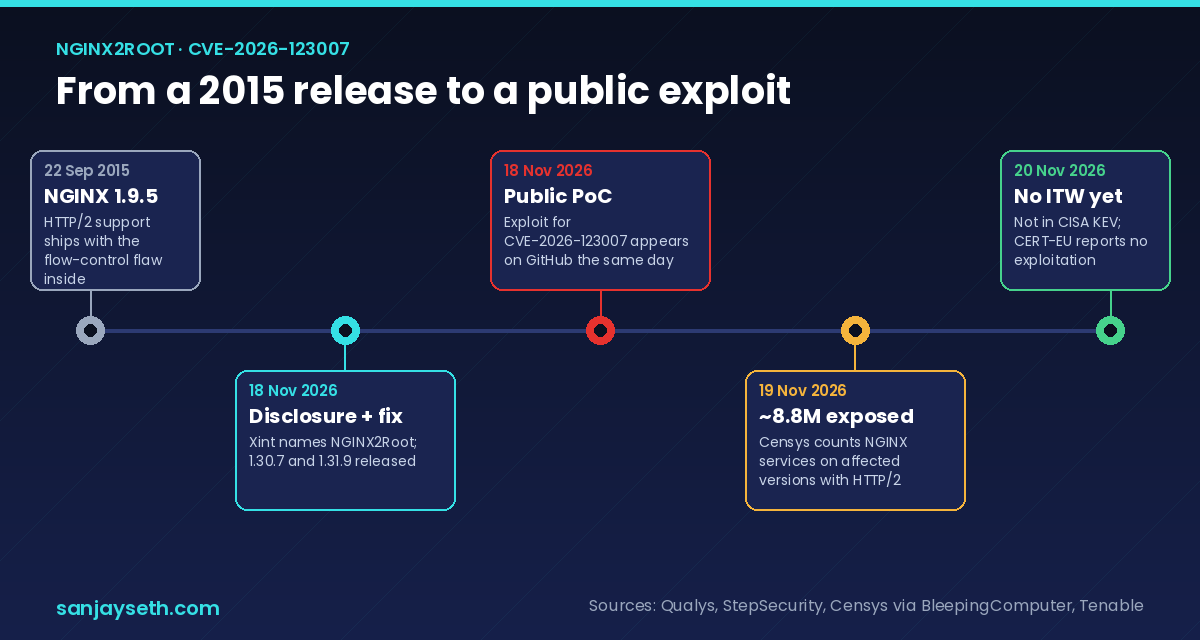
Think about where NGINX sits in your estate. It’s in front of the ERP portal, inside the Kubernetes cluster, on the reverse proxy in front of a payment API, and probably inside a few appliances nobody thinks of as web servers. On 18 November 2026 that software got its worst bug in years. CVE-2026-123007, the lead flaw in a set of five that researchers at Xint call NGINX2Root, lets an unauthenticated attacker run code on an NGINX server over HTTP/2. The bug has been in the code since version 1.9.5, released in September 2015. The fix and a public exploit came out on the same day.
I want to be straight about the risk, because this one is easy to overhype. As of 20 November nobody had reported exploitation in the wild, CISA hadn’t added it to the KEV catalog, and the public exploit is slow and fussy. None of that is a reason to wait. A reverse proxy sees your decrypted traffic and talks to every backend you put behind it, and once a reliable exploit exists, attackers don’t wait for a headline.
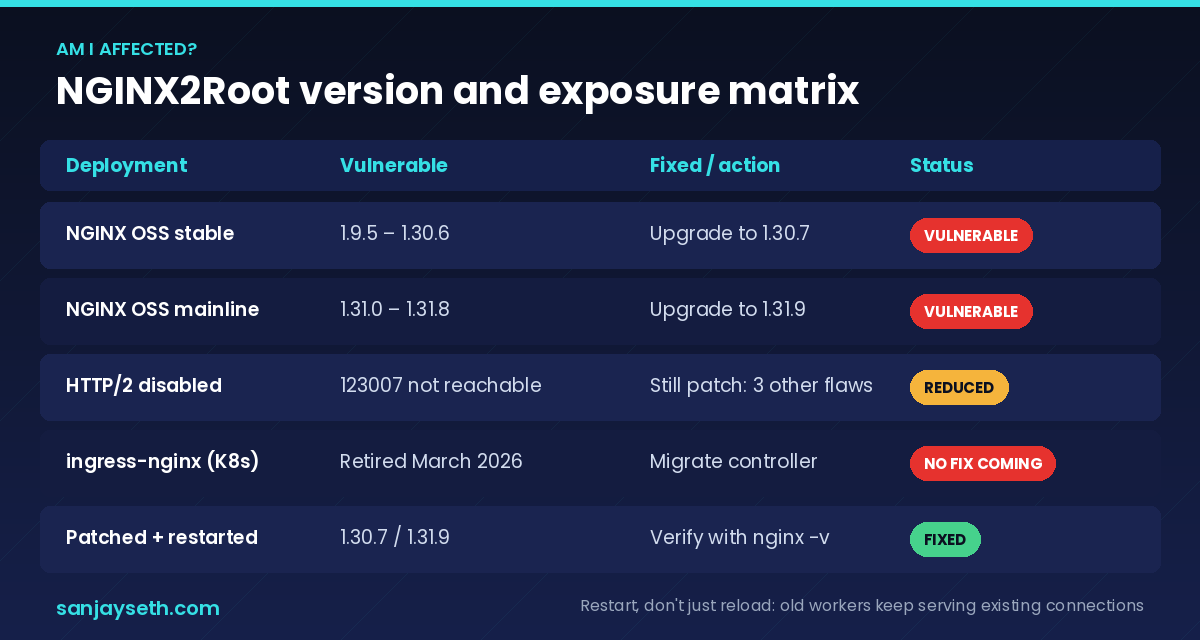
The short answer: if any NGINX you run is on 1.9.5 to 1.30.6 or 1.31.0 to 1.31.8 with HTTP/2 enabled, upgrade to 1.30.7 or 1.31.9 and restart the service today. If you can’t, turn HTTP/2 off as a stop-gap and disable the kernel SCTP module. Then finish the upgrade, because switching HTTP/2 off doesn’t block the other flaws in the set.
Key takeaways
- CVE-2026-123007 is an integer underflow in NGINX’s HTTP/2 flow-control accounting. An unauthenticated attacker can use it to run code as the NGINX worker process.
- A second critical flaw in the set, CVE-2026-123633, is a use-after-free in the same HTTP/2 code. It’s narrower, because NGINX must be proxying to a backend.
- Fix: NGINX 1.30.7 (stable) or 1.31.9 (mainline), released 18 November. Restart after upgrading. A reload can leave old workers serving existing connections.
- Xint reached root by chaining the bug with an unpatched Linux kernel SCTP use-after-free that had no CVE as of 19 November.
- Turning HTTP/2 off blocks CVE-2026-123007 but not the rest of the set. Use it as a stop-gap only.
- The community Kubernetes ingress-nginx controller was retired in March 2026 and won’t get a fix. Plan your migration.
01What happened
Xint disclosed the NGINX2Root set on 18 November 2026, and the NGINX project shipped 1.31.9 (mainline) and 1.30.7 (stable) the same day. Details are on the NGINX security advisories page. A proof-of-concept for the lead bug was on GitHub within hours, and Qualys and Tenable both published guidance that week.
The next day, Censys counted roughly 8.8 million internet-facing NGINX services running an affected version with HTTP/2 enabled, as BleepingComputer reported. That’s an exposure count, not a victim count. Plenty of those servers sit behind a CDN or won’t fall to the public code, but the number shows how large the target pool is.
On severity, F5 scores all five flaws 9.2 (Critical) under CVSS 4.0 and 8.1 (High) under CVSS 3.1, and Red Hat rates CVE-2026-123007 Critical. If your scanner shows “High” and the team has parked it on that basis, show them this paragraph.
02How the attack works
HTTP/2 carries many requests over one connection and uses a flow-control window so a fast sender can’t swamp a slow receiver. Each side tells the other how much data it may send, and NGINX keeps a running count. CVE-2026-123007 is an integer underflow in that count. Push it below zero with the right sequence of HTTP/2 control traffic and it wraps round to a huge number, which corrupts memory the worker depends on. As The Hacker News points out, the flaw has been there since HTTP/2 support first shipped.
Code execution lands as the NGINX worker user, not root. The “2Root” half of the name comes from a second step: Xint showed the worker foothold can be chained with a separate, still-unpatched use-after-free in the Linux kernel’s SCTP code to escalate to root. That’s why my hardening list below includes switching SCTP off.
Even without root, a hijacked worker on a reverse proxy is bad news. It handles decrypted user traffic and connects to your internal upstreams with whatever trust they give the proxy. If those upstreams accept anything that comes from the proxy’s IP, the attacker inherits that trust.
| Attribute | Detail |
|---|---|
| Lead CVE | CVE-2026-123007, integer underflow in HTTP/2 flow control |
| Companion CVE | CVE-2026-123633, use-after-free in HTTP/2, needs reverse-proxy mode |
| Authentication | None |
| Affected | NGINX Open Source 1.9.5 to 1.30.6 and 1.31.0 to 1.31.8, with HTTP/2 enabled |
| Fixed in | 1.30.7 (stable), 1.31.9 (mainline) |
| Scores | CVSS 4.0 9.2 · CVSS 3.1 8.1 (F5); Red Hat: Critical |
| Root chain | Linux kernel SCTP use-after-free, unpatched, no CVE as of 19 Nov |
| Exploitation | Public PoC; none reported in the wild as of 20 Nov; not in CISA KEV |
03Am I affected?
Start with the easy part. On each server, check the version and whether HTTP/2 is switched on anywhere in the configuration:
nginx -v
# is HTTP/2 enabled? (http2 directive or legacy listen flag)
grep -RniE “^\s*http2\s+on|listen[^;]*http2” /etc/nginx/
# NGINX inside containers
docker exec <container> nginx -v
kubectl exec -n <namespace> <pod> — nginx -v
# is the kernel SCTP module loaded?
lsmod | grep sctp
Then look past the obvious web servers. In most estates I review, NGINX also turns up in monitoring stacks, developer tools, vendor appliances and container images that nobody lists as a web server. Container images are the sneaky ones. The host’s package manager won’t touch them, so you have to rebuild from a fixed base image and redeploy.
Distribution packages need a different check. Debian, Ubuntu, RHEL and others often ship the fix as a backport under an older-looking version number, so search your distro’s security tracker for CVE-2026-123007 instead of comparing numbers with upstream. For NGINX Plus, follow F5’s own advisory.
If you run the community Kubernetes ingress-nginx controller, no patched release is coming. The Kubernetes project retired it in March 2026, with no further releases or security fixes. Treat NGINX2Root as the push to move to Gateway API or a maintained controller.
04How worried should you be today?
Here’s my honest read as of 20 November. No exploitation in the wild has been confirmed, and StepSecurity notes that CERT-EU says the same. The public exploit is hard to use: it holds one HTTP/2 connection open and sends a huge number of control messages for several minutes, it has to reach NGINX directly, and it depends on a specific memory-copy routine in the standard Linux C library.
That buys you days, not months. Qualys reports that the NGINX2Root researchers have their own exploit working against servers on public cloud addresses and are holding back the final steps. Exploit code only gets better, and a slow, noisy exploit still works against a server nobody watches.
The noise helps defenders. One client holding an HTTP/2 connection open for minutes and pumping control frames looks nothing like a browser. Failed memory-corruption attempts also tend to crash workers, and NGINX logs those as a worker process that “exited on signal 11”. If your SIEM collects NGINX error logs, that’s a rule you can write this afternoon.
If this feels familiar, it should. A few weeks ago I wrote about CVE-2026-119618 in Apache’s mod_http2. HTTP/2 implementations are complicated state machines, and they keep producing this class of bug.
05What you should do today
This is the order I’m giving clients. A public PoC against an internet-facing component is reason enough to skip the next change window.
- Inventory every NGINX. Include containers, ingress controllers and appliances. Record the version, whether HTTP/2 is on, and whether it faces the internet. Internet-facing reverse proxies go first.
- Upgrade to 1.30.7 or 1.31.9, or your distro’s fixed package. Then run
systemctl restart nginx, notnginx -s reload. A reload keeps old workers alive to finish existing connections, and long-lived HTTP/2 connections can keep them around for hours. Confirm withnginx -von every node. - Rebuild container images. Pull a fixed base image, rebuild and redeploy. Patching the host does nothing for NGINX inside a container.
- Can’t patch today? Use the stop-gap. Turn HTTP/2 off on exposed server blocks (
http2 off;on 1.25.1 and later, or removehttp2from thelistenline on older builds). It blocks CVE-2026-123007, not the rest of the set, so keep the upgrade on today’s list. - Close the root path. Web servers almost never need SCTP. Add
install sctp /bin/falseto a file under/etc/modprobe.d/, and unload the module iflsmodshows it. CIS benchmarks recommend this anyway, and it removes the escalation Xint used until a kernel fix ships. - Watch for the exploit pattern. Alert on worker crashes (signal 11) and on single clients holding HTTP/2 connections open for minutes. At the perimeter, check whether your IPS vendor has published a signature for CVE-2026-123007, and remember an IPS can only see HTTP/2 frames where it decrypts inbound TLS. On a FortiGate, that means an SSL server-protection (inbound deep inspection) profile on the policies for your published servers.
- If you find anything, treat it as a breach. Isolate the host, preserve logs, reissue the TLS certificates the proxy used and rotate every upstream credential in its configuration.
The deeper lesson is one I keep repeating: your reverse proxy isn’t a trust boundary. If a hijacked NGINX worker can reach your database, your identity provider and your admin interfaces directly, your segmentation isn’t protecting much. A zero-trust segmentation design lets the proxy reach only the upstreams it serves, and nothing else.
06How PrahiX ORA could have saved you
Let me be clear about the limits first. No platform patches NGINX for you. The upgrade and the restart are your team’s job. What a platform can do is make sure you know every NGINX you own, spot the exploit pattern when it starts, and contain a hijacked host before it turns into a breach. That’s the job of PrahiX ORA, a unified SecOps platform built by PrahiX Tech Pvt Ltd. P J Networks is its field deployment and operations partner, and it’s the platform we deploy and run for clients.
Where a Fortinet SOC stack stops, and what PrahiX adds
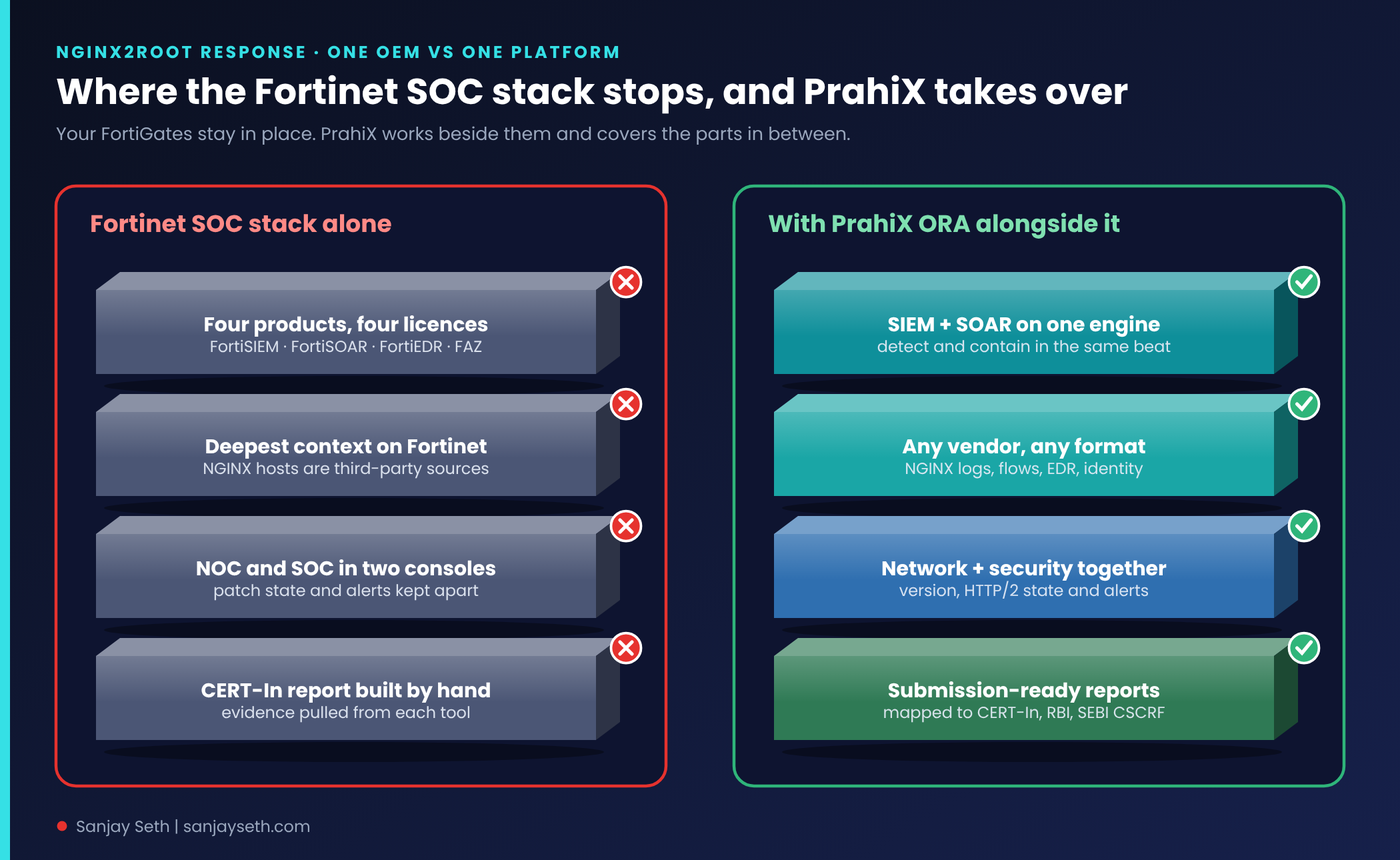
Most of my clients run FortiGate at the edge, and with good reason. The firewall, IPS and SSL inspection are strong, and FortiAnalyzer gives clean per-device reporting. The NGINX2Root question is what happens around the firewall, on the Linux hosts and containers it doesn’t manage.
| With Fortinet alone | With PrahiX |
|---|---|
| A full SOC means FortiSIEM, FortiSOAR, FortiEDR and FortiAnalyzer: separate products with separate licences, sizing and upgrade cycles, joined by Security Fabric connectors. | SIEM and SOAR run on one engine and one data model in PrahiX Uni, so the detection and the containment playbook work on the same incident. |
| The deepest context is on Fortinet telemetry. Your NGINX hosts, container images and Linux kernels are third-party sources. | Any vendor, any format: NGINX error and access logs, NetFlow and IPFIX, Linux and endpoint telemetry, each tied to its asset, site and user. Parser Lab adds a new source when you need one. |
| Network and security operations sit in different consoles, so “which NGINX is still on 1.30.6?” and “which one is crashing?” are answered in different places. | Network, infrastructure and security in one console, with agentless discovery of model and firmware, plus configuration snapshots and diffs. |
| FortiAnalyzer retention depends on its storage and licensed log volume. | Logs deduplicated on arrival, searchable within about ten seconds and kept for 180 days, with tiered hot, cold and archive storage. |
| Indian regulator submissions (CERT-In, SEBI CSCRF, IRDAI) are usually assembled by hand. | Compliance mapped to CERT-In 2022, the RBI IT framework, SEBI CSCRF and IRDAI with submission-ready reports, and CERT-In advisories ingested automatically. |
Beyond Fortinet: how the other OEMs compare
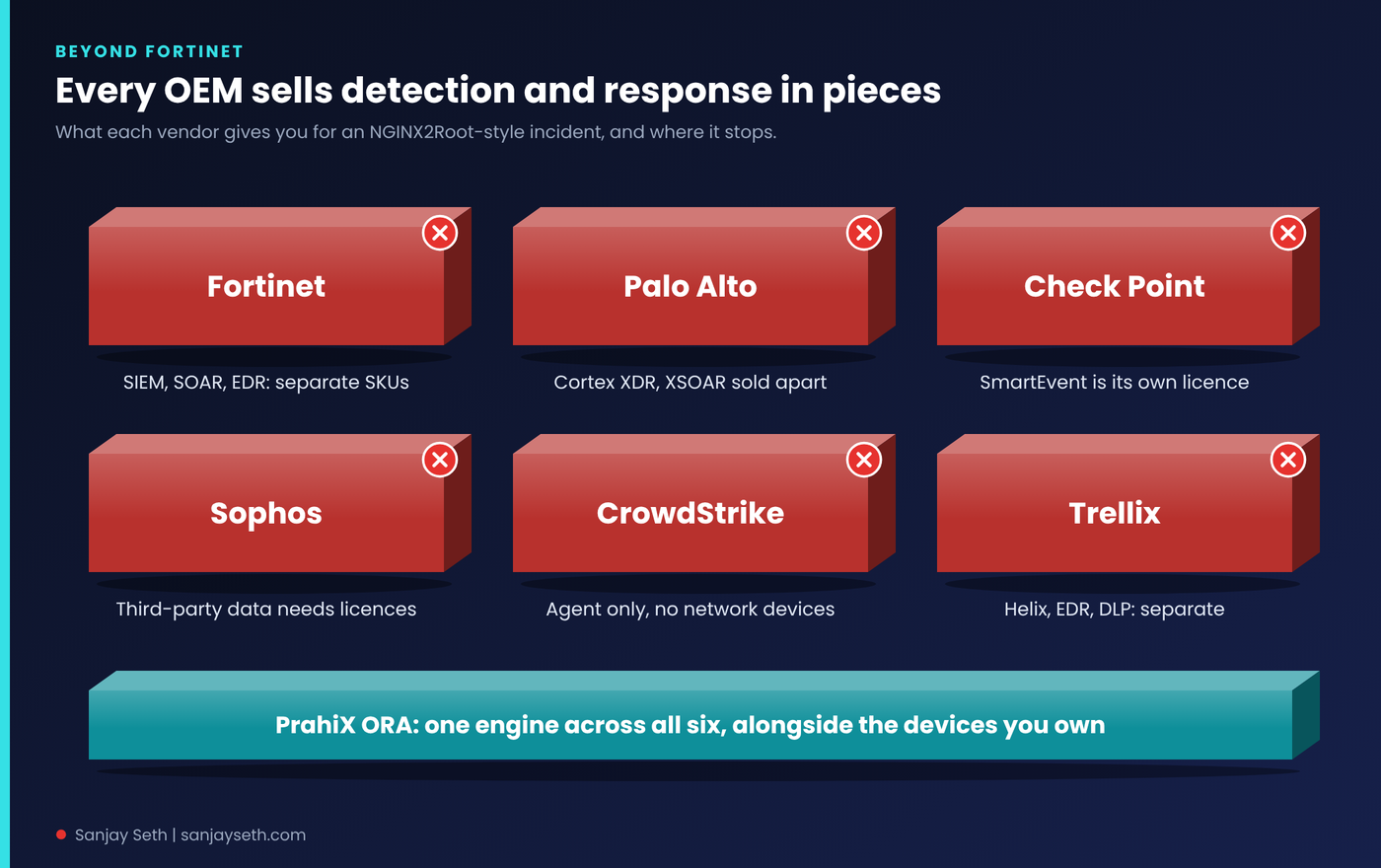
This isn’t a Fortinet problem. Every major OEM sells detection and response as separate pieces, and each console sees its own devices best. Here’s how that plays out for an NGINX2Root-style incident.
| OEM | What you get, and where it stops |
|---|---|
| Fortinet | Strong edge IPS and SSL inspection. A SOC needs FortiSIEM, FortiSOAR, FortiEDR and FortiAnalyzer, each a separate product. |
| Palo Alto Networks | Panorama manages and logs PAN-OS firewalls. Cortex XDR, XSOAR and XSIAM are separate products, and Strata Logging Service retention depends on the storage purchased. |
| Check Point | The management server covers Check Point gateways. SmartEvent correlation is a separately licensed blade, and Infinity XDR/XPR is another subscription. |
| Sophos | Sophos Central covers Sophos firewalls, switches and endpoints. XDR and MDR are built on Sophos telemetry first, and third-party sources need integration licences. |
| CrowdStrike | Falcon covers hosts that run its agent. Firewalls and switches can’t run it, network device health is out of scope, and Next-Gen SIEM’s third-party ingestion is licensed by volume. |
| Trellix | ePO manages Trellix agents. Helix, Trellix EDR and Trellix DLP are separate products, and network device health is out of scope. |
| PrahiX | Works alongside all of them, with pre-built connectors for FortiGate, Palo Alto, Sophos, Check Point and Cisco ASA firewalls and for CrowdStrike, SentinelOne, Carbon Black and Microsoft Defender, and one engine for detection and response. |
Stage by stage: NGINX2Root against ORA
| What the attacker does | What ORA and RAYA AI do |
|---|---|
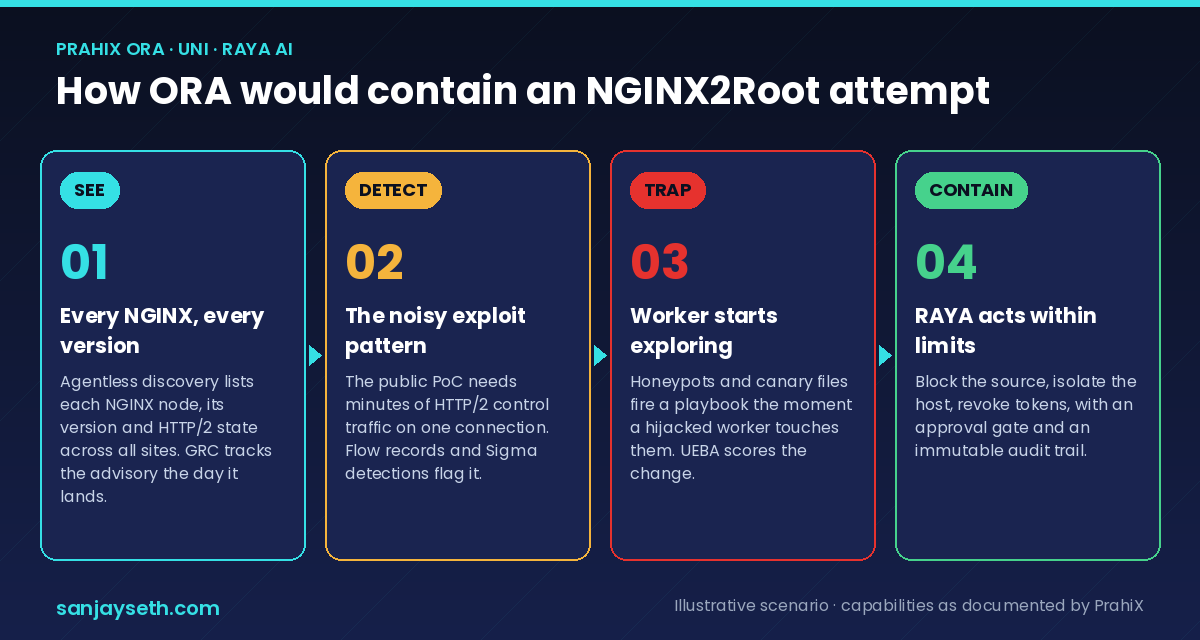
| Before: unpatched NGINX nodes that nobody has listed | See. Agentless discovery puts every node, its version and lifecycle data on one console. GRC tracks the advisory, and CERT-In advisories arrive in threat intelligence automatically. |
| Exploit attempt: minutes of HTTP/2 control traffic on one connection | Detect. Flow records and NGINX logs are correlated within about ten seconds. Sigma detections mapped to MITRE ATT&CK flag the long-lived connection and the worker crashes, and IOC matching runs against 10+ threat-intel feeds. |
| Worker foothold: the process starts exploring | Trap. Honeypots and canary files trigger a playbook. UEBA scores the host’s new behaviour, and the attack storyline builds from initial access. |
| Escalation and theft | Contain. RAYA AI runs the containment you’ve allowed: block the source, isolate the host, revoke tokens. Approval gates sit on anything disruptive, and every step goes into an immutable audit trail. |
| After: Board and regulator questions | Report. RAYA writes the incident narrative and an executive summary, and reports map to CERT-In and the sector regulators. |
The rest of the PrahiX family, one hook each
Monitoring, AIOps, SIEM, SOAR and self-healing in one product, with up to 70% less alert noise and early warning 15 to 45 minutes before users feel a problem.
Links what belongs together, finds the root cause, writes the incident story and acts only within the limits you set.
Agentless health, configuration diffs and firmware visibility across Cisco, Juniper, Fortinet, Aruba, HPE and others.
If the proxy fronted systems holding personal data, live breach clocks (CERT-In 6 hours, DP Board 72 hours) start when the incident is logged.
Video surveillance (VMS) on the same console, so a server-room access event and a server alert share one timeline.
Guest Wi-Fi with versioned consent records beside your firewalls, so the visitor network stays separate from the servers it should never reach.
The honest bottom line
ORA would not have upgraded your NGINX. It would have given you a complete list of NGINX nodes on the day the advisory landed, turned a noisy exploit attempt into a P1 incident with its cause already written, and contained a hijacked worker before it reached your upstreams. The upgrade, the restart and the SCTP change still belong to your team. ORA makes sure you’re never the last to know. See how we run it on the PrahiX ORA page, read why P J Networks is an implementation partner for PrahiX, or book an ORA demo with us.
07The India angle
Indian organisations put NGINX almost everywhere during the last few years of digital rollouts: payment gateways, e-commerce storefronts, hospital portals and e-governance front-ends. A lot of it runs on long-lived VMs and in container images built once and left alone. Those are exactly the instances most likely to be sitting on 1.20-something with HTTP/2 switched on.
CERT-In’s April 2022 directions require cyber incidents to be reported within six hours of noticing them, and logs to be kept for 180 days within India. So you need your NGINX logs somewhere searchable before an incident, not after. For RBI-, SEBI CSCRF- and IRDAI-regulated entities, a public exploit against an internet-facing component is the kind of exposure auditors ask about at the next review. Have your inventory, patch evidence and restart confirmation ready.
08Frequently asked questions
Does turning off HTTP/2 fully protect my NGINX server?
No. Disabling HTTP/2 blocks CVE-2026-123007, and incident-response guidance says it also blocks CVE-2026-123633, but it doesn’t block the other three flaws in the NGINX2Root set. Use it to buy a day or two, then upgrade to 1.30.7 or 1.31.9 and restart.
We sit behind a CDN or cloud load balancer. Are we safe?
Safer, not safe. The public exploit has to reach NGINX directly, so an edge that ends HTTP/2 and talks HTTP/1.1 to your origin cuts that path. Check whether your origin accepts HTTP/2 from the edge, and whether anyone can reach it directly by IP address from the internet.
Is CVE-2026-123007 being exploited in the wild?
As of 20 November 2026, no exploitation had been publicly reported and the CVE wasn’t in CISA’s KEV catalog. A public PoC exists, and the researchers report a more reliable private exploit, so this can change quickly. Patch on the assumption that it will.
How do I check NGINX inside Docker or Kubernetes?
Run nginx -v inside the container with docker exec or kubectl exec, or check the image’s software bill of materials. Rebuild from a fixed base image, because patching the host won’t help. The community ingress-nginx controller is retired, so migrate rather than wait for a fix.
Not sure how many NGINX servers you really have?
My team at P J Networks can find every NGINX across your hosts, containers and appliances, plan the upgrades, apply the stop-gaps safely, and send NGINX logs into PrahiX so the next HTTP/2 bug shows up as a dashboard alert rather than a breach.
Sources
- NGINX security advisories
- BleepingComputer: Critical NGINX “NGINX2Root” bugs let attackers hijack servers
- The Hacker News: 10-year-old NGINX HTTP/2 flaw lets unauthenticated attackers execute code
- Qualys: NGINX2Root, five NGINX flaws led by CVE-2026-123007
- Tenable: NGINX2Root FAQ
- StepSecurity: nginx2root (CVE-2026-123007) analysis
- Kubernetes: Ingress NGINX retirement
- NVD: CVE-2026-123007