FBI NCIC Breach Investigation: What’s Confirmed, What Isn’t, and What CISOs Should Do
The FBI is reportedly investigating an apparent breach of the National Crime Information Center (NCIC), the database every American police officer leans on during a traffic stop. CNN broke the story on Friday, 20 November 2026, citing two people briefed on the investigation. The FBI has not confirmed it publicly. Nobody outside the investigation yet knows how the attackers got in, when, or whether a single record was read, copied or changed.
Stories like this get inflated fast, so I’ve kept this briefing deliberately strict. Below is what’s on the record, what’s only reported, and what’s still unknown. Then comes the part that matters for those of us running security in India: what a breach of a shared, many-tenant database teaches anyone who operates one.
Key takeaways
- CNN reports the FBI is investigating an apparent NCIC breach, discovered “in recent days”. The FBI hasn’t commented.
- It’s unknown when access began, how attackers got in, what they could reach, and whether NCIC’s availability to police was affected.
- It follows the September ShinyHunters claim against FBIJobs.gov, but there is no indication the two are connected.
- Separately, USDA took several applications offline after an incident its own security team uncovered. Again, no reported link.
- The lesson for CISOs is about shared databases with thousands of connected users: identity, behaviour baselines and export monitoring matter more than the perimeter.
01What NCIC is, and why it matters
NCIC is the FBI-run index that local, state and federal agencies use to share records on wanted and missing persons, outstanding warrants, stolen vehicles and firearms, and protection orders. An officer at a roadside runs a plate or a name, and NCIC answers in seconds. It’s also used in investigations and background checks. It sits under the FBI’s Criminal Justice Information Services (CJIS) Division and has been running since 1967.
That’s why this one stings even before we know the facts. The risk isn’t only theft. A database that decides whether an officer treats a driver as dangerous is also a database where tampering, a fake warrant or a deleted protection order, could cause real harm. A retired FBI agent made exactly that point to Fox News, warning about officer safety at traffic stops. To be clear, nobody has reported any tampering. It’s simply the scenario investigators have to rule out.
02What’s reported, and what isn’t
According to BleepingComputer’s write-up of CNN’s reporting, the intrusion was discovered in recent days. It’s unclear when it happened, how the attackers gained access, or whether any information was stolen. The FBI did not respond to CNN or to BleepingComputer. Everything public today traces back to unnamed people briefed on the investigation.
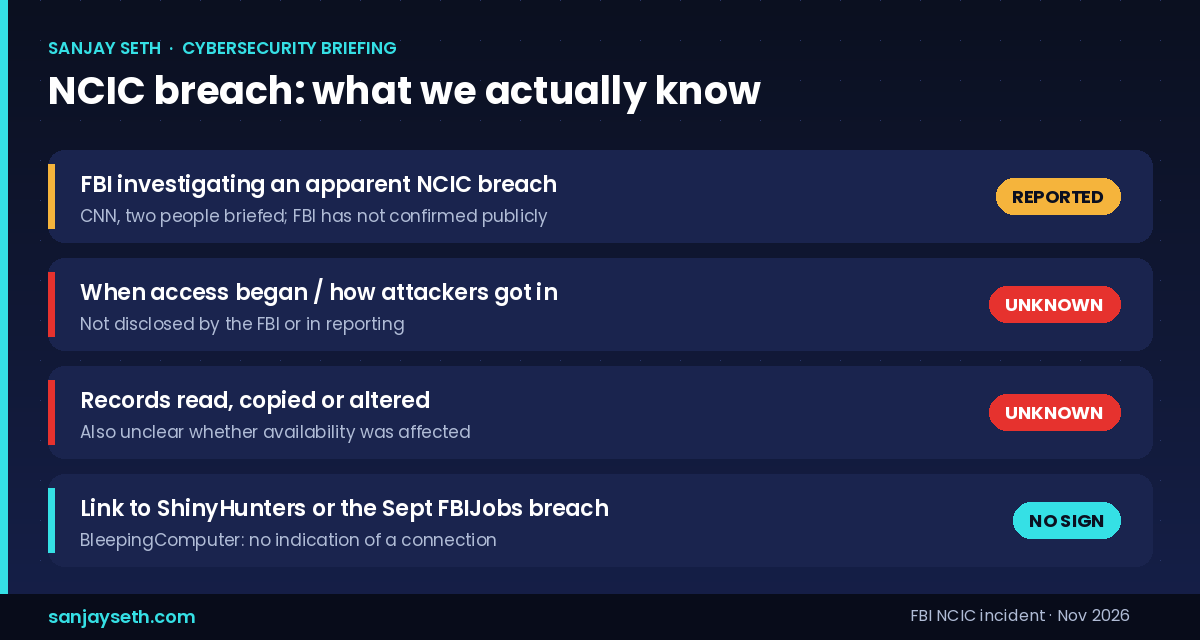
| Question | Status | Source |
|---|---|---|
| Is the FBI investigating an NCIC breach? | Reported | CNN, two people briefed |
| Has the FBI confirmed it? | No public statement | No response to CNN or BleepingComputer |
| Attack vector | Unknown | Not disclosed |
| Records accessed, copied or altered | Unknown | Not disclosed |
| Impact on police access to NCIC | Unknown | BleepingComputer |
| Who did it | Unattributed | No attribution reported |
| Linked to ShinyHunters / September breach | No indication | BleepingComputer |
03The context: September’s FBIJobs incident
This is the second FBI-related incident in two months. On 22 September, the extortion group ShinyHunters claimed to have stolen data on FBI agents and job applicants. BleepingComputer reports the group said it got in through an unpatched Oracle PeopleSoft vulnerability on a third-party platform behind FBIJobs.gov. A sample reviewed by journalists appeared to cover about 5,000 people, with names, addresses, phone numbers and dates of birth. The full scope was never confirmed.
The FBI’s response was quick. ShinyHunters’ leak site went offline at the end of September, and the bureau made arrests, including, BleepingComputer says, a Canadian cybersecurity executive reportedly linked to the attacks. A further suspect was arrested on 9 October.
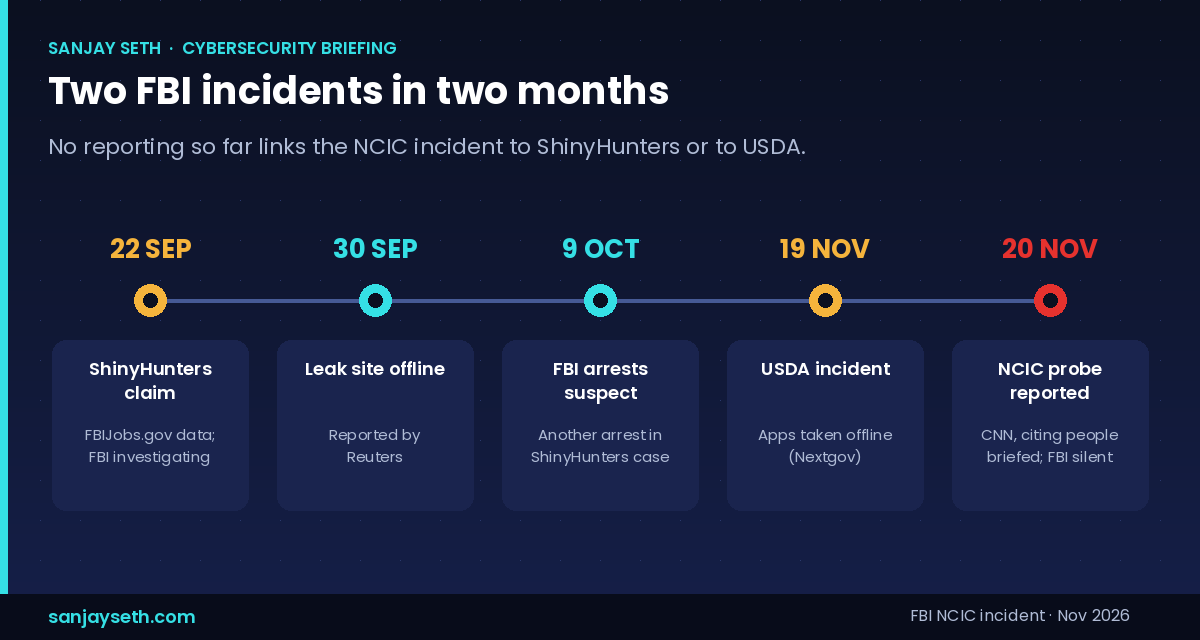
In the same week, Nextgov reported that USDA’s Cybersecurity and Privacy Operations Center “uncovered a security incident” and that numerous applications were taken offline over several days. It’s tempting to call this a campaign against US agencies. The honest position is that nothing published connects the three.
04Why a shared database is a special risk
I don’t know how NCIC was reached, and I won’t pretend to. What I do know, from years of building networks for organisations with hundreds of branches, is how shared databases with thousands of connected users tend to fail. The core system is often well defended. The risk comes from who is allowed to query it:
- Too many legitimate front doors. Every connected office, terminal and integration is an identity that can query real data. A stolen credential looks exactly like a normal user.
- Third parties in the path. September’s FBIJobs incident reportedly came through a third-party platform. I’ve written about the same pattern in TSMC’s cloud-vendor leak and the n0n gang’s attack on Visa’s APAC vendor.
- Integrity, not just confidentiality. Most monitoring watches for data leaving. Far fewer teams watch for records being changed by an account that’s allowed to change them.
- Slow detection. If “normal” query behaviour isn’t baselined per user, a slow, careful attacker can run for months.
05What you should do
If you run any central database that many offices, partners or apps can query, such as a bank’s core system, a hospital record system or a state citizen database, this is the checklist I’d work through this week.
- Inventory every identity that can query the data. Include service accounts, API keys and partner integrations, not just people. Kill anything dormant.
- Enforce phishing-resistant MFA on every query path, including the “trusted” internal ones. Credential theft is the cheapest way into a shared database.
- Baseline per-user behaviour. Volume, time of day, record types, location. Alert on deviation, not just on failed logins.
- Monitor writes and deletes as closely as reads. Log record changes with who, what, when and from where, and alert on unusual modification patterns.
- Patch internet-facing third-party platforms on the same SLA as your own. September’s incident reportedly came through an unpatched vendor system.
- Rehearse the first hour. Know who can suspend a partner’s access, who tells the regulator and who preserves evidence. My notes on the first 60 minutes of an incident are a good starting template.
06How PrahiX ORA could have saved you
First, the honest limit. The NCIC attack path isn’t public, so I can’t claim any product “would have stopped” this breach. No platform patches a third party’s PeopleSoft server for them either. What both FBI stories do show is the pattern behind most data breaches in shared systems: a partner or third party is the way in, a valid-looking account does the reading, and the data leaves quietly while each tool sees only its own fragment. That fragmentation is exactly what PrahiX ORA is built to remove. Identity, database, network and data-movement signals land in one place, and RAYA AI turns them into one incident with its cause.
Stage by stage: what ORA would have done
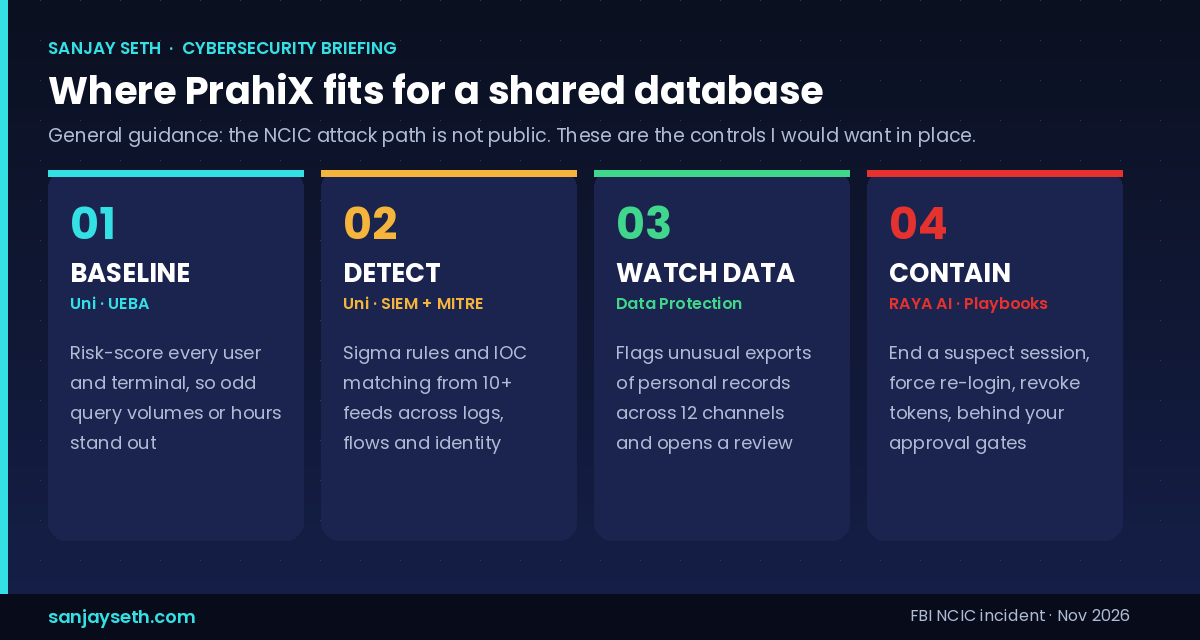
Because the NCIC path isn’t disclosed, this table maps the stages that were reported in September, plus the typical stages of a shared-database breach, to ORA’s four steps.
| Breach stage (reported or typical) | What ORA and RAYA do |
|---|---|
| Before: an unpatched system at a third party (reported in September) | Ingest + awareness. Agentless discovery (SNMP, SSH, REST APIs) and topology mapping show which partner connections reach your data. GRC auto-ingests CERT-In advisories into threat intelligence, so an exposed version is on someone’s list the day the advisory lands. |
| Initial access through the partner path | Correlate. Identity, VPN and flow records sit together and stay fresh within 10 seconds. Sigma detections mapped to MITRE ATT&CK and IOC matching from 10+ threat-intel feeds flag a known-bad source or an impossible sign-in. |
| Reading the data with a valid-looking account | UEBA risk-scores the account when it queries at odd hours or in odd volumes. Attack storylines join the sign-in, the queries and the host into one kill chain instead of three tickets. |
| Exfiltration of personal records | PrahiX Data Protection watches personal-data movement across 12 channels and flags an unusual export, opening a review. Honeypots and canary files fire a playbook the moment quiet reconnaissance touches them. |
| Containment | Respond. RAYA ends the unusual session, forces re-login, revokes tokens or blocks the address, with an approval gate on anything disruptive. Every step lands in one immutable audit trail, which is what investigators will ask for. |
| After: regulators, the Board and the people whose data it was | GRC starts the breach clocks when the incident is logged (CERT-In 6 hours, DP Board 72 hours). Data Protection drafts reports for CERT-In, the DPDP Board, RBI, SEBI and IRDAI. Evolve: each outcome sharpens the next response. |
What’s inside PrahiX ORA
Collects every signal from any vendor or format, ties it to an asset, site and user, and runs four automatic steps: Ingest → Correlate → Respond → Evolve.
The agent inside ORA. It joins related alerts into one incident with a root cause, self-heals within your limits and rolls back a failed fix. It also warns 15–45 minutes before users feel a problem and writes a plain-language morning summary.
Every site, device and service live on one screen. Role-based views and a library of ready-made dashboards let you go from a chart to an incident, device or log line in one click.
Tracks CERT-In, DPDP Act, RBI, SEBI CSCRF, IRDAI, ISO 27001 and more. It shows what’s due and what’s missing, and produces sealed evidence and ready-to-submit reports.
Monitoring, AIOps, SIEM, SOAR and self-healing in one product: Sigma detections mapped to MITRE ATT&CK, UEBA, attack storylines, deception, playbooks with approval gates and 180 days of searchable logs.
Finds personal data (14 Indian identifiers) and stops leakage across 12 channels. It also tracks every DPDP Act clock, with 62 controls on one scorecard.
REST APIs and webhooks to the tools you already run. Parser Lab adds any source in any format, and detections and playbooks are kept as version-controlled code.
Multi-tenant from one site to 100+ client tenants, with India compliance built in plus CIS v8, NIST CSF, PCI-DSS, HIPAA, ISO 27001 and SOC 2 mappings. Made in India.
The honest bottom line
ORA would not have patched a third party’s PeopleSoft server, and nobody outside the investigation knows how NCIC was reached. What ORA changes is the shape of the incident. A partner login at an odd hour, a spike in queries and a large export stop being three unrelated tickets in three tools. They become one P1 with its cause written up, a session RAYA can end in minutes, and breach clocks that start on time. Strong identity, patching and least privilege still come first. ORA makes sure you hear about a leak from your own console, not from the news. P J Networks is an implementation partner for PrahiX, and we run ORA deployments end to end. Book an ORA demo with us.
07The India angle
India has its own shared crime-records backbone in the NCRB’s Crime and Criminal Tracking Network & Systems (CCTNS), which links police stations across states. Banks, insurers, telecoms and state governments run their own large shared databases too, from core banking to citizen-service portals. The questions this incident raises apply to all of them. Who can query the data? Would you notice if a legitimate account started behaving differently? Could you prove a record wasn’t altered?
The regulatory stakes are real. CERT-In expects a cyber incident to be reported within six hours of being noticed. Under the DPDP Act, failing to take reasonable security safeguards can draw penalties of up to ₹250 crore. If you’re building toward that, start with identity-driven zero-trust segmentation so that every query path is authenticated and logged.
08Frequently asked questions
Has the FBI confirmed the NCIC breach?
Not publicly, as of 22 November 2026. CNN reported the investigation on 20 November, citing two people briefed on it. The FBI did not respond to requests for comment from CNN or BleepingComputer.
Was any NCIC data stolen or changed?
It isn’t known. Reporting says it’s unclear whether attackers accessed records stored in NCIC, copied or altered anything, or affected police agencies’ ability to use the system.
Is the NCIC incident linked to ShinyHunters?
There is no indication of a link. ShinyHunters claimed the September breach of FBIJobs.gov, reportedly through an unpatched Oracle PeopleSoft flaw on a third-party platform, and several suspects were later arrested. Nothing published connects that case to NCIC.
What should Indian organisations take from this?
Treat every identity that can query a shared database as a possible entry point. Enforce strong MFA, baseline per-user behaviour, monitor changes as well as exports, and rehearse your CERT-In six-hour reporting process.
How exposed is your shared data?
My team at P J Networks can review who can query your critical databases, test your detection of credential misuse and bulk exports, and set up PrahiX so an unusual query or export becomes an alert in minutes rather than a headline months later.
Request a security assessment →Sources
- BleepingComputer: FBI reportedly hacked again, this time targeting nationwide police database (21 Nov 2026)
- Nextgov/FCW: USDA grapples with security breach as IT staff take multiple systems offline (19 Nov 2026)
- Axios: FBI investigates hackers’ claims of massive data theft (22 Sep 2026)
- Fox News: Retired FBI agent warns NCIC breach could threaten police safety
- PrahiX Uni product page · PrahiX Data Protection